
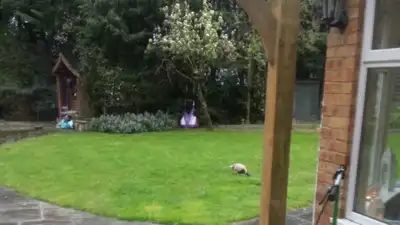
View from Robert McCarthy’s home towards the old Leylandii trees at the bottom of the garden. (Photos: The Standard)
Couple said they stopped using their garden
Three siblings in Essex were ordered to pay about £30,500 in damages and £178,668 in their neighbours’ legal costs after cutting down a row of 33-foot Leylandii trees during a long-running boundary dispute. The dispute involved Robert McCarthy, 59, his wife Amanda, 61, and their neighbours Foulla Bowler, 61, John Barberis, 63, and Mary Englishby, 59, according to The Standard. The McCarthys had lived in their home in Nazeing, Essex, since 2001, while Bowler had grown up in the neighbouring family home, which she now owns with her brother and sister. But around 2018, a dispute began over where the actual boundary between the gardens lay. The disagreement eventually led to the removal of the fence and the cutting down of most of the trees in January 2022. Bowler had applied in 2018 for permission to fell 29 trees. At a further hearing this week, Judge Saggerson ordered the siblings to pay around £30,500 in damages and £178,668 towards the McCarthys’ legal costs. From January 2022 I accept that the claimants had to live more and more, almost exclusively, at the front of their house,” he said.
Bowler and her siblings claimed the boundary was beyond the fence and that the trees therefore stood on their land. Because they were causing ‘overshadowing’ and could potentially damage their property, they said they had the right to remove them.
The McCarthys said the loss of the trees left their garden exposed, damaged their privacy and changed how they used their home. Robert McCarthy said the trees were already well established at the time. “The trees were well-established when we moved in,” he told the judge, as quoted by The Standard. Christopher Coyle, the family later went ahead with the removal, with the felling continuing into a second day even after the McCarthys’ lawyers had written to ask them to stop, according to the McCarthys’ barrister. Robert McCarthy described the work as an “invasion” and said it had resulted in a “relentless destruction of my garden. I want my privacy back like I had,” he told the court. The McCarthys told the court that the removal of the trees had affected their family’s everyday life. They said they no longer felt comfortable using the back garden and had stopped inviting people, including their children’s friends, to their home. Amanda McCarthy said they had “only ever used the front rooms of their house” since the trees were removed. She also told the court that she had become “depressed as a result of the stress that has been caused”. Since the invasion we don’t use the garden at all,” she said. The judge said the siblings had taken “unilateral action to re-order the disputed boundary” during what he described as “fence wars” between the neighbours. He also said their evidence was less reliable and less accurate than that of the McCarthys. Instead, he said they had “persuaded themselves of the righteousness of their own case. The judge said the cutting down of the trees had caused a trespass and had a serious effect on the McCarthys’ use of their property. It opened up their rear garden to the unwanted attention of their neighbours,” he said. The judge also referred to “unfortunate acrimonious shouting and terms of abuse being hurled from the defendants’ garden into the claimants’ garden”. He said the couple had stopped inviting people round and that their children had particularly stopped inviting friends. He said, “No reasonable person spending their own money would do this,” and instead awarded the couple £5,000 for smaller trees that could be planted and allowed to grow.
The court found that the siblings had trespassed into their neighbours’ garden and acted in a ‘high-handed’ and ‘bullying’ manner. The two properties were separated by a fence, with a line of Leylandii trees on the McCarthys’ side. They later took the siblings to court. The court heard that the McCarthys believed the old fence marked the boundary when they bought their home. “We thought the chain link fence was the boundary as it ran along. I had no reason not to believe that to be the boundary,” McCarthy added. The siblings, however, maintained that the fence and trees were actually on their land. The dispute continued for several years. This is how we feel as a family. I can stand upstairs in my house and they can see me walking around. “After the invasion it feels completely destroyed. There’s little or nothing left of what was our garden. Foulla Bowler and John Barberis outside Central London County Court. The couple had sought compensation that included the cost of planting new trees and restoring their privacy. They also asked the court to declare that the true boundary was the line of the old fence. He found that the siblings had trespassed into the neighbours’ garden when they removed the trees. However, he did not find that the siblings were lying. The amount comes on top of the siblings’ own court costs. “The centre of gravity in this case is the cutting down of trees on or around the border, which in my judgment caused a trespass and had a serious impact on the claimants’ amenity in a number of ways. “The loss of privacy was significant in a domestic situation such as this. Judge Saggerson refused to award that amount.
In an earlier judgment following a trial, Judge Alan Saggerson ruled in favour of the McCarthys on the location of the boundary.

The McCarthys had sought enough money to replace the removed trees with new trees measuring about 8 metres tall. That work was estimated to cost £105,000.
The judge further said the situation had a detrimental effect on Amanda McCarthy’s mental health. He also criticised the siblings’ “aggressive and somewhat bullying behaviour”. It goes way beyond the ordinary course of trespass,” he said.
“It seems clear to me that the claimants have been victimised by high-handed oppressive behaviour.
Following the ruling, the three siblings are selling their childhood home, according to the court hearing. The judge also noted that the siblings’ property was being marketed, or was expected to be marketed. You use AI every day. Now get your AI Quotient. Take the AIQ test.