
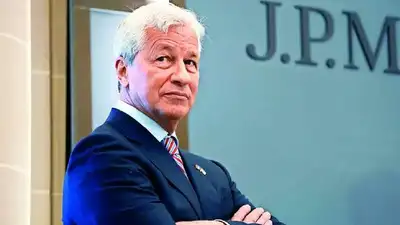
“I believe the U.S. should offer Europe a major inducement: If it executes meaningful economic and military reforms… the US will negotiate one big, beautiful economic and free-trade agreement with Europe,” Dimon wrote. Jamie Dimon, the CEO of America’s largest bank JPMorgan Chase has renewed his warning that Europe risks falling behind economically, while proposing what he called a ‘big beautiful’ free-trade agreement with the United States as part of a broader effort to strengthen the Western alliance. In an opinion piece published in The Wall Street Journal, Dimon argued that Washington should offer Europe a sweeping economic partnership if the continent implements meaningful economic and military reforms designed to boost growth, competitiveness and security.
Such an agreement would go beyond Europe and could eventually be extended to friendly democracies including Canada, Mexico, Japan, South Korea, Australia and the Philippines, according to Dimon. He described deeper economic integration among democratic allies as a potential “game changer” that would allow them to set global trade rules, strengthen economic resilience and present a united front against geopolitical pressures. A combination of US leadership and successful European reforms could create a stronger Western bloc capable of driving economic growth and addressing long-term geopolitical challenges, according to Dimon. “A renewed commitment to American values and alliances coupled with bold reforms by Europe would be a geopolitical and economic home run, guaranteeing the Western world’s strength for the next 250 years,” he wrote.
Dimon’s proposal contrasts with the more protectionist approach adopted by the administration of Donald Trump, whose tariff policies have strained relations with several trading partners, including the European Union and Canada. Dimon’s op-ed didn’t just float a vague aspiration — it named specific reforms he believes are prerequisites. He called on the European Union to finally complete its long-delayed Capital Markets Union and Banking Union to boost competitiveness, to follow through on the recommendations laid out in the Draghi report, and to secure genuine independence in defense, manufacturing, and energy. He argued that a Europe capable of mobilizing capital, scaling innovative companies, consolidating defense production, and reducing strategic dependencies would emerge as a stronger security partner, a more resilient economic partner, and a more credible counterweight to China’s growing economic influence. Beyond Europe, Dimon argued that the United States must also take steps to preserve its position as the world’s leading economic and military power. He called for renewed focus on strengthening the American economy, expanding opportunity and reinforcing democratic alliances. This isn’t the first time Dimon has bluntly criticized Europe’s economic standing. You use AI every day. Now get your AI Quotient. Take the AIQ test.
Last year, speaking to European business and political leaders at an event in Ireland, he delivered an even more direct version of the same warning, telling the room flatly that, compared with the US and Asia, Europe is losing.