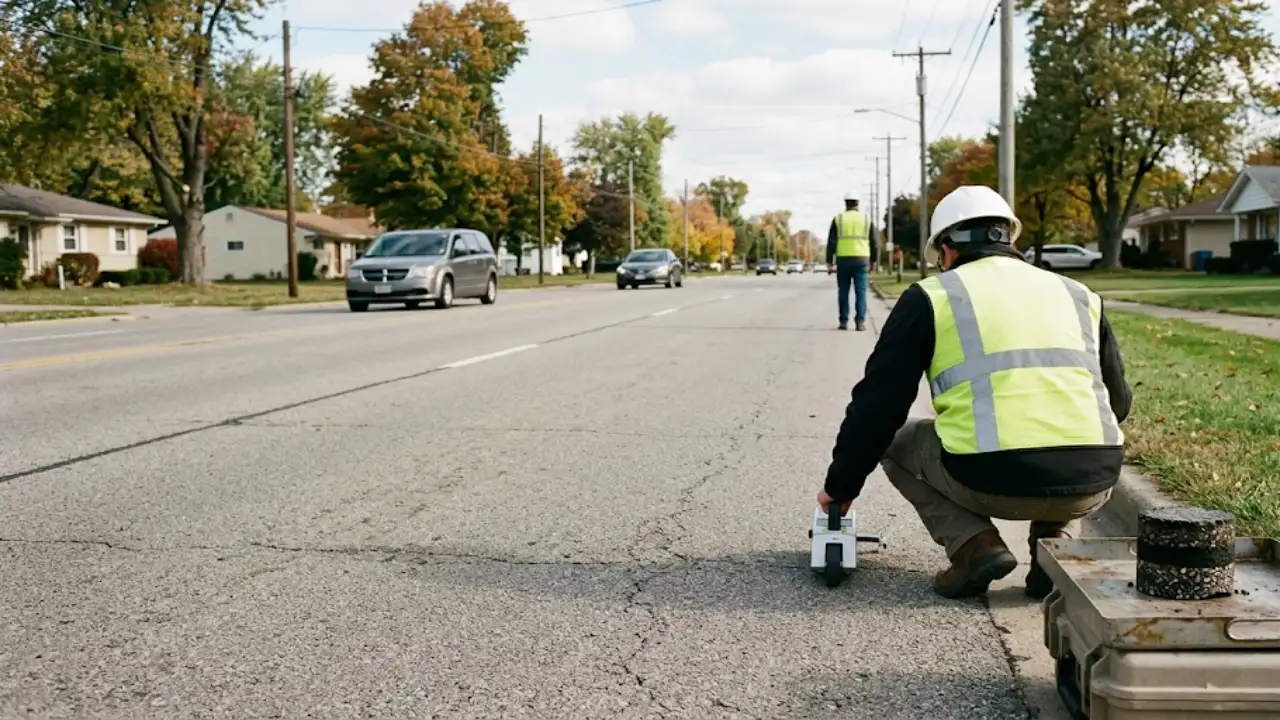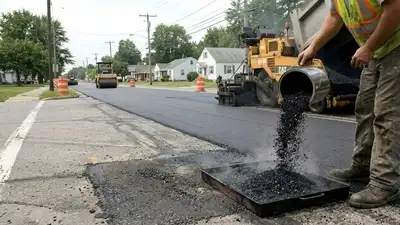
AI-generated representative image showing ground tire rubber being incorporated into asphalt during a road resurfacing project. Credits – Gemini
After four years, the rating reached 87%, and during the ten-year observation period, it barely altered. Department of Transportation research archive says the new surface was a one-inch overlay applied in 2005 across a one-mile stretch. The most popping number from the project is the 87% pavement condition rating. After four years, the PCR increased to 87% and then remained fairly steady, while the GTR and polymer-modified parts had the same PCR score in all years studied, according to the research. Transverse cracks emerged after around 2 years; non-wheel-track longitudinal cracks after 4 years. The study followed both for 10 years and found them to perform well with no significant difference in the pavement condition assessment. The King Road project was one of the comparisons with a polymer-modified control, and 10-year field data were part of the study on GTR asphalt performance and life-cycle costs. Over a decade of service, it remained equivalent to the polymer-modified control while reaching the same 87% PCR level. it did indicate that in this particular one-mile stretch of Sylvania, the recycled method can hold its own over time While the road didn’t prove all tire-rubber pavement can last 10 years.
The good 10-year performance in the Ohio research itself may have been due to the increased asphalt content used in the combinations on King Road and the relatively low traffic flow on that road. Because the rubber piece didn’t only survive a few years, the finding is nevertheless remarkable. Because both sides of the road have similar surroundings and traffic, the comparison is especially important.
The tyre rubber part and the control had the same pavement condition rating in every year reported in the study, which was a noteworthy outcome of ten years of monitoring.
Rubber-modified asphalt is not always superior, according to the test. On one side of the road, engineers applied a one-inch layer of ground tyre rubber as an asphalt overlay, while on the other side, a polymer-modified asphalt portion served as the control. The design of both blends met the Ohio Department of Transportation’s requirements. It has been shown that recycled tyre rubber can create a pavement section with long-term performance comparable to the conventional control under the conditions on King Road. The project uses the existing flexible pavement on King Road, Sylvania. The Ohio field report published through the U.S. There were no cracks in the pavement. The fissures became more severe with time. The fourth year was the moment when crack sealing was required. Still, the two parts moved closer together. These conclusions are further validated by a separate long-term assessment of many Ohio GTR programs. Road authorities can use material from discarded tyres to add tyre rubber to asphalt for building of pavements. Ground rubber can change the properties of the asphalt binder, but the ultimate result relies on the rubber, binder, aggregate, mix design, traffic and climate. King Road is thus a representative field example, not a universal formula. The use of a control section was employed in an effort to assess if the rubber-modified surface was deviating from normal polymer-modified pavement rather than assessing its condition alone. The Ohio research subsequently incorporated the topic into a larger study of GTR pavement performance. That means the King Road project is a real-world test of recycled material against a conventional option.