
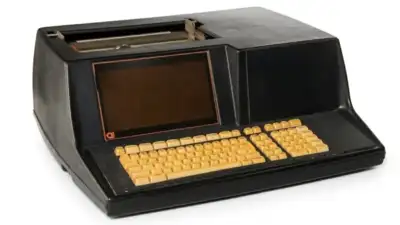
In 2023, a London house-clearance crew found two old computers buried under boxes; they were two of only three known surviving Q1 microcomputers, and the 1972 model later sold for £37,179/Image: Heritage Auctions via SWNS
The world’s first fully integrated desktop computer was found among boxes during a London house clearance in 2023, with one of the rare machines later sold for £37,179 at auction. The find included a 1972 Q1 desktop microcomputer with an internal printer and its slightly later sibling, the Q1 Lite. The computers were discovered by house-clearance firm Just Clear while workers were clearing a London property. Only three Q1 microcomputers are known to have survived, making the two machines particularly rare. A companion printer designed for the Q1 Lite was also found during the clearance.
“It is a real bonus being able to feature two Q1s, the world’s earliest microcomputers, at Kingston University,” Neve told New Atlas. He said the computers developed during the 1970s and 1980s helped establish the foundations for modern machines used for work, communication, productivity and entertainment.
The 1972 Q1 achieved the highest price, selling for £37,179. The Q1 Lite sold for £8,316, while its companion printer fetched £1,175. The Q1 dates back to 1972, four years before Steve Wozniak and Steve Jobs introduced the Apple 1. The 1972 Q1 with its internal printer sold for £37,179, while the later Q1 Lite reached £8,316. The separate Q1 companion printer sold for £1,175.
Because the machines had never previously been auctioned, the Heritage sale was also significant.
Paul Neve, a senior lecturer at Kingston University, said having two Q1 machines available for the exhibition offered an opportunity to show the technology that preceded modern computers. Before the bidding began, Sara Balbi, managing director of Heritage Auctions’ London office, said there was no established auction record for the Q1s that could indicate how much buyers might pay. We’ll have to see what the market decides,” Balbi said.
The three devices were later offered for the first time at auction by Dallas-based Heritage Auctions. All three machines were sold without a reserve. “Keep in mind these have never been to auction, and there is no record or precedent set for them. The eventual results put a value on the rare pieces of computing history. You use AI every day. Now get your AI Quotient. Take the AIQ test.
The machine used a microprocessor-based architecture that allowed it to deliver capabilities that had previously been associated with much larger computer systems.
The machines would have cost the equivalent of more than £70,000 each, making them too expensive to be marketed for individual use. The Q1, Q1 Lite and companion printer were displayed at Kingston University in London in February 2024, as part of an exhibition titled Creating the Everything Device: Showcasing the Machines That Built the Future .
Valarie Spiegel, Heritage Auctions’ director of video games, said the technology allowed the Q1 to “punch well above its weight” and established an important precedent for the computing industry. The Q1 was also far from affordable by the standards of the time. Despite that limitation, the Q1 represented an early step towards the development of computers that could eventually become part of everyday life. The computers did not go directly from the London house clearance to the auction block. The exhibition focused on early computers and gaming machines and placed the newly discovered Q1s alongside other examples of early technology.