
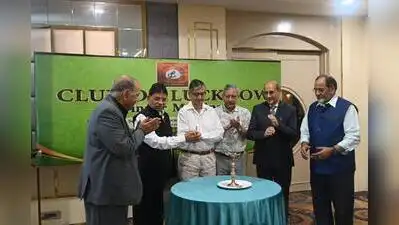
OP Srivastava (third from left), director of ‘The Dirty Sky’, with other guests during the inauguration of the programme on Sunday
The idea came from there,” he said. He said the rapid expansion of satellite constellations was adding to the problem, while there was still no comprehensive global agreement governing space debris. Srivastava highlights how collisions can create thousands of additional fragments, threatening operational satellites and astronauts. “The issue was not limited to space agencies, warning that the growing debris could pose potential hazards for people on Earth and future space exploration,” said Srivastava. He highlighted the growing threat of space debris and the risks it poses to future space missions and life on Earth. “When two satellites collided in space, I read the news and started researching about it. With communication, navigation, weather forecasting, digital payments and emergency services increasingly dependent on satellites, damage in orbit could have consequences far beyond space.
Lucknow: The sky may look empty, but it is increasingly becoming a crowded highway of dead satellites, discarded rocket parts and fragments travelling at speeds capable of damaging spacecraft, said O P Srivastava, director of the documentary ‘The Dirty Sky’, on Sunday.
Debris in space is moving at 1,80,000 mph. It can be as small as 1 mm to as big as a spacecraft.
More than one million objects are floating in space,” he said. “The next war will be of space.