
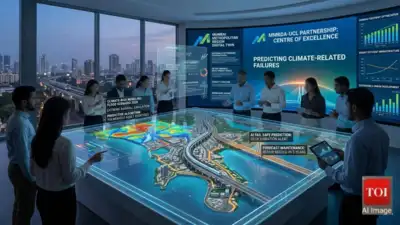
AI-powered digital twins could help Mumbai predict infrastructure failures and prepare for climate risks before disasters strike.
MUMBAI: Mumbai’s infrastructure planning could move towards predicting climate-related failures rather than responding to them after they occur, with the MMRDA and University College London (UCL) exploring the use of artificial intelligence, digital twins and climate-risk modelling to manage roads, transport networks, utilities and other critical assets across the metropolitan region.
The Mumbai Metropolitan Region Development Authority and UCL have signed an MoU to explore a long-term partnership on climate-resilient urban systems and sustainable urban and regional development. The collaboration could help turn environmental and infrastructure data into tools to identify vulnerable assets, forecast maintenance needs and guide investment in areas exposed to flooding, extreme weather and other climate risks. For instance, sensors and AI could monitor a bridge or metro viaduct for cracks, vibration and other signs of deterioration, allowing MMRDA to schedule repairs before a safety issue or prolonged closure occurs. For a new project, a digital twin could simulate extreme rainfall and water flow, helping planners identify vulnerable sections and incorporate adequate drainage and flood protection into the design. At its centre is a proposal to establish a metropolitan-scale Centre of Excellence for research, innovation, capacity building and knowledge exchange. The partnership will cover transport infrastructure, public utilities, buildings and ecological assets, with a focus on climate-adaptive planning, nature-based solutions, energy efficiency and emissions reduction.
Dr Sanjay Mukherjee, metropolitan commissioner, MMRDA, said, “By bringing areas such as climate-risk assessment, resilient asset management, AI, climate analytics and digital twins closer to planning and operations, we can translate research into practical solutions.” Joint research will include climate-risk modelling, energy mapping, environmental impact assessment, carbon-footprint optimisation and circular-economy practices. The institutions will also explore international benchmarks and methodologies linked to India’s Nationally Determined Contributions under the Paris Agreement and the UN Sustainable Development Goals.