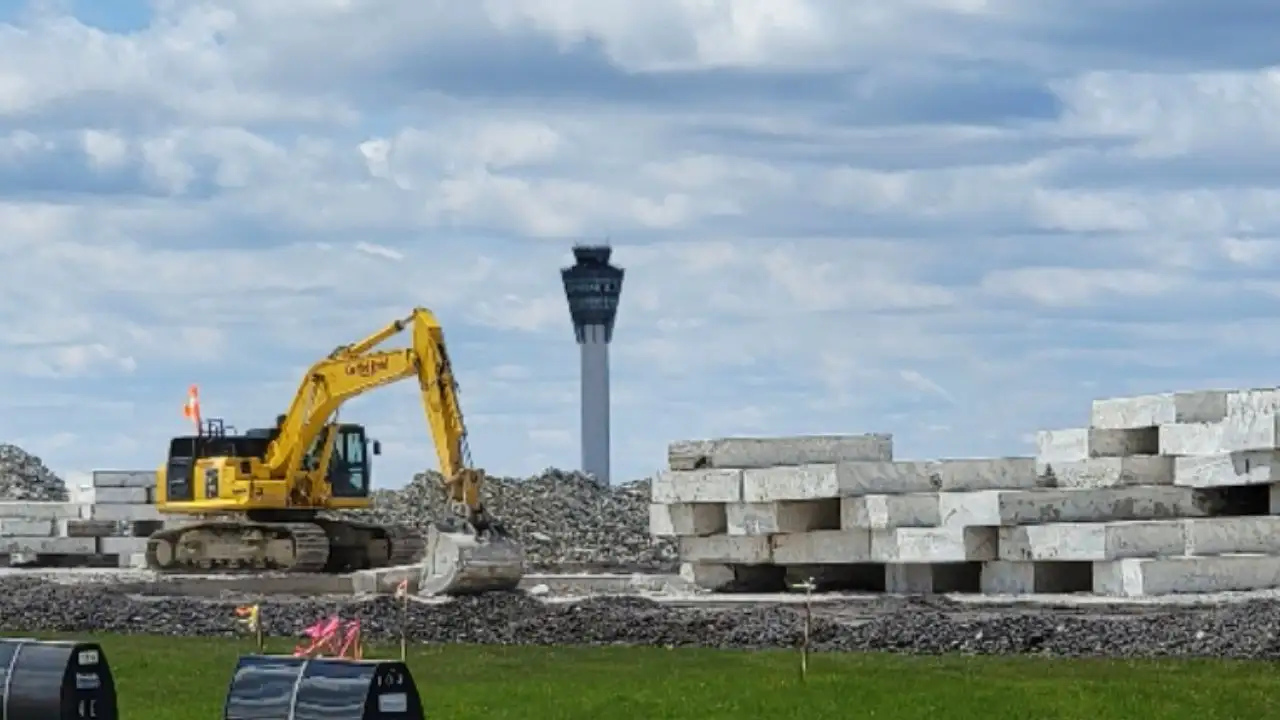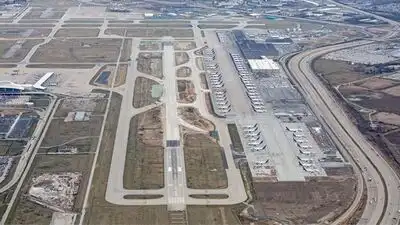
In an industry first, Indy airport is using carbon capture technology on a full runway. Image Credit: Indianapolis Airport Authority/Engineering News-Record
Indianapolis International Airport rebuilt its 10,000-foot-long Runway 5R-23L with concrete designed to capture and permanently store carbon dioxide inside the pavement. The $190 million reconstruction project introduced carbon-capture technology to an entire airport runway after receiving approval from the Federal Aviation Administration. The 22-inch top concrete layer of the reconstructed runway contains the captured carbon. Engineering News-Record reported that the amount of carbon expected to be stored was equivalent to the carbon associated with planting about 1.2 million trees. The FAA approved the use of the technology across the full 10,000-foot-long and 150-foot-wide runway, making the project a significant step for the use of carbon-capture concrete in airfield construction. The Sustainable Infrastructure report describes it as a 150-foot-wide, 10,000-foot-long runway forming part of the airport’s southeast-side facilities. Kimley-Horn reported that the wider project reconstructed more than 450,000 square yards of concrete pavement while adding new LED lighting, signs, a firefighting water line and upgraded navigation aids. Engineering News-Record reported that the existing runway, which was about 30 years old, was expected to have a 40-year life after reconstruction rather than the previous 20-year expectation. Kimley-Horn later reported that the wider project diverted nearly 690,000 tons of waste from landfill, achieving a diversion rate of more than 99%. The project also used recycled non-potable water for activities including dust control, compaction and irrigation, reducing the use of drinking-quality water by 50%, according to Kimley-Horn. The Indianapolis Airport Authority said the reconstruction included a 1,000-kilowatt direct-current solar photovoltaic system along with battery storage. The Sustainable Infrastructure report estimated that the solar installation would generate 1,552,341 kilowatt-hours of electricity each year, compared with an estimated 419,060 kilowatt-hours required by the project itself. Kimley-Horn reported that the completed project also included a 10-acre photovoltaic solar array and two battery storage systems. Kimley-Horn projected that the updated system could reduce operational energy consumption by 31% compared with the previous system. The Indianapolis Airport Authority said the $190 million project was the first airfield project in the world to receive the Platinum designation.According to the Indianapolis Airport Authority, the project was expected to create more than 2,700 jobs, while economic analysis found that every dollar spent on the reconstruction would generate another $0.80 in economic activity in Marion County.
Because it handles most of the airport’s cargo operations as well as a substantial amount of commercial airline traffic, runway 5R-23L is an important part of Indianapolis International Airport. Because runway 5R-23L sits beside the airport’s major FedEx cargo operation, kimley-Horn described the project as a multi-year effort shaped by extensive coordination.
The Indianapolis Airport Authority said the project was recognised with the Envision Platinum Award, the highest level awarded by the Institute for Sustainable Infrastructure. The system introduces recycled carbon dioxide into freshly mixed concrete during production, according to Engineering News-Record. The Indianapolis Airport Authority said the existing runway concrete would be crushed on site and recycled into the new project.
It combined the new concrete system with recycled construction materials, renewable energy and upgrades intended to improve the runway for decades. The central innovation is the use of CarbonCure technology in the concrete. The gas then undergoes mineralisation, turning it into a solid mineral and permanently embedding it in the pavement. The Sustainable Infrastructure report explains that the project uses post-industrial CO2 in fresh concrete, where it converts into calcium carbonate. The process is intended to reduce the amount of carbon associated with the concrete while also improving its compressive strength without affecting other important properties of the material. This was not simply a small demonstration section. The reconstruction replaced the existing pavement with full-depth Portland cement concrete and included changes to the taxiway, drainage, markings, signs, lighting and navigation equipment. The pavement was also designed with longevity in mind. An analysis led the project team to increase the pavement depth by an inch. Concrete slabs are laid at Indianapolis International Airport. Image Credit: Woolpert/Institute for Sustainable Infrastructure Much of the material removed during construction did not simply become waste. Crushed concrete was reused as aggregate base material and pipe bedding, reducing the need to transport replacement materials. Other materials were also put to use. Signs and lighting removed from the project were transferred for reuse at other airports in Indiana. These measures made material reuse a major part of the reconstruction rather than treating sustainability as something limited to the concrete mix. The runway project also incorporated renewable energy. The surplus electricity was intended to serve other airfield electrical systems beyond the immediate construction area. These systems were designed to supply power to the Midfield Vault and one of the airport’s aircraft rescue and firefighting facilities. LED lighting and signage were another part of the work. The combination of carbon capture, material reuse, renewable energy and other measures helped the project receive the Envision Platinum Award from the Institute for Sustainable Infrastructure. Construction had to be phased carefully to limit disruption while maintaining safe airport operations. You use AI every day. Now get your AI Quotient. Take the AIQ test.