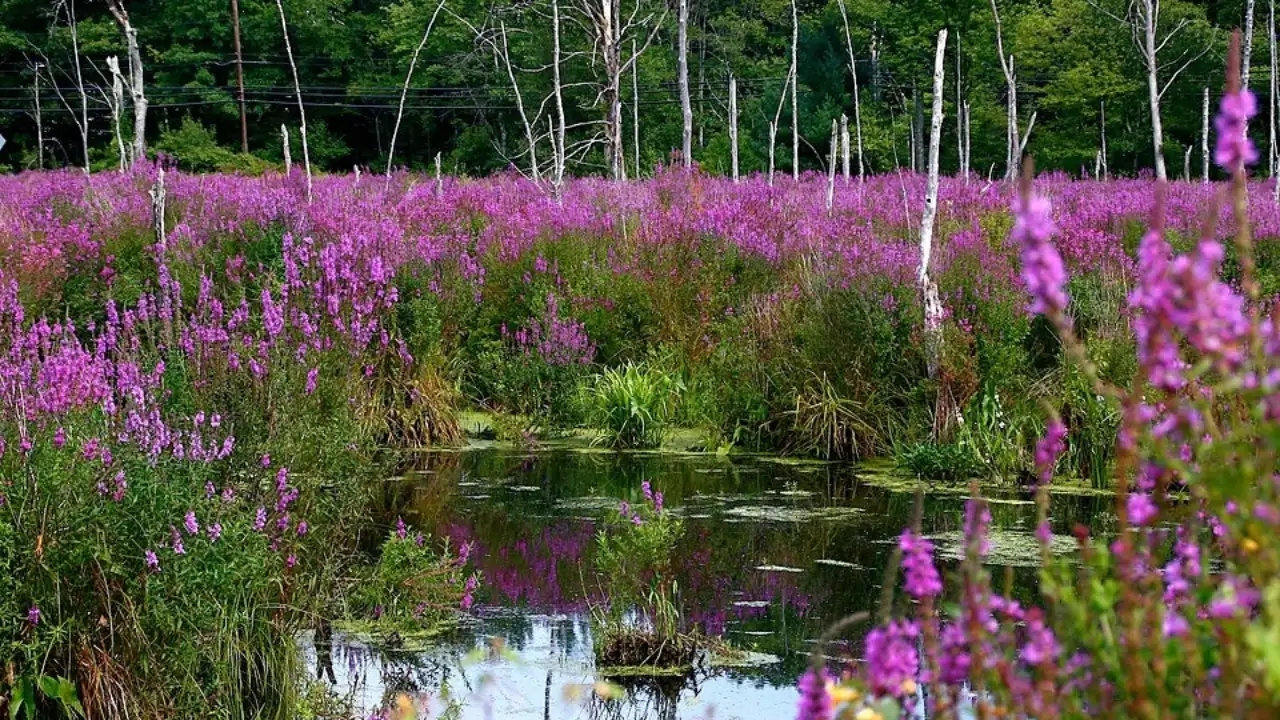
The perennial wetland plant eventually spread through waterways and disturbed wetlands across the United States | Wikimedia Commons
The perennial wetland plant eventually spread through waterways and disturbed wetlands across the United States, with an estimate cited by government land managers that puts its range at about 500,000 acres across the northern United States and southern Canada. The flowers came with an unusual growth pattern Purple loosestrife can produce dense stands after they have been established, and USDA Forest Service material reports that infestations can reach densities of 80,000 stalks per acre. The National Park Service says a single stalk can produce as many as 300,000 seeds, while an established plant can have 30 or more stems and produce millions of seeds in a year, which are carried into new wetland areas through wind and water. The scale of the spread had become large enough for land managers to track it across regions by the late 20th century | Wikimedia Commons A garden plant became a wetland problem The scale of the spread had become large enough for land managers to track it across regions by the late 20th century, and a Massachusetts watershed management document estimated that purple loosestrife covered about 500,000 acres in northern U.S. and southern Canada and was present in most wetlands used by breeding waterfowl along the Atlantic and Mississippi flyways. The figure was an estimate of the area that was affected by the plant across the region, and the USDA Forest Service separately records the species as occurring in all but six states of the continental United States in its 2002 review, with the Midwest and Northeast among its main concentrations.
USDA Forest Service researchers say that it was introduced to the northeastern United States and Canada in the 1800s, probably through several routes, with seeds having arrived in ship ballast and animal wool, while the plant also intentionally being imported for ornamental and medicinal use.
Forest Service says that purple loosestrife was well established in coastal New England wetlands by the 1830s, and later introductions and natural spread carried it inland along canals, rivers and the Great Lakes. Its review also says ornamental cultivars have contributed to the plant’s spread and recommends discouraging their planting in areas that are vulnerable to invasion. Purple loosestrife came to North America in the 1800s with European settlers, and some of the plant was brought in specifically for ornamental and medicinal purposes. Purple loosestrife produces tall stems that are topped with dense spikes of purple flowers, and was used as a garden plant in various parts of North America. The U.S. Its expansion accelerated during the 20th century, and became especially common in wetlands and other moist areas. The plant can also reproduce in several ways, which gives established populations more than one route to expand. The plant’s ability to form dense stands became a problem for native wetland vegetation, and when purple loosestrife dominates an area, native plants can lose space and access to resources, which can affect the wildlife that depends on those plants. Forest Service describes purple loosestrife as an invasive species and notes that dense, nearly single-species stands can dominate wetland plant communities. The same plant that had once been valued for its flowers was now being managed as an invasive species, and states began to restrict its sale and distribution, while researchers developed biological-control programs using insects from purple loosestrife’s native range. The flowers remain distinctive, but the plant is no longer viewed just as an ornamental. Its dense growth can replace native vegetation and make control increasingly difficult in wetlands where it becomes established. You use AI every day. Now get your AI Quotient. Take the AIQ test.