
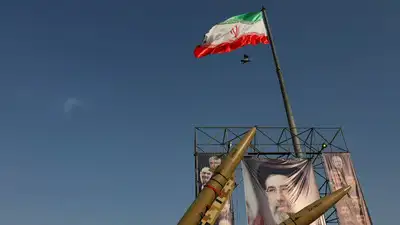
File photo: Iranian missiles are displayed next to a banner with a picture of Iran’s Supreme Leader, Mojtaba Khamenei, on a street in Tehran, Iran
Iran has strengthened defences around sensitive nuclear sites and stepped up efforts to rally domestic support as it prepares for possible renewed US strikes after the November 3 midterm elections, the Wall Street Journal reported. The warnings, conveyed by Iranian officials in public statements and private conversations with regional counterparts, are part of Tehran’s effort to deter potential American attacks after the November 3 midterm elections.
Some Iranian officials have hinted that Iranian forces could cross into neighbouring countries if Washington resumes strikes, people familiar with the warnings told the WSJ. Tehran has separately warned Arab officials that it could strike regional targets, including Saudi oil facilities, if hostilities resume, according to people familiar with the discussions. Tehran has also warned regional officials that a fresh conflict could spill across the Gulf, with threats of land incursions into neighbouring countries and attacks on regional infrastructure, US forces and commercial shipping. Such threats would add to the security concerns facing Saudi Arabia, which has also come under attack from Yemen’s Iran-backed Houthi rebels.
Iran’s top national security official, Mohsen Rezaei, said on Sunday that Tehran could target the United Arab Emirates, as well as data centres and internet cables across the region.
Earlier reporting noted: “The war footing is serving them well for now due to an impasse on many fronts—diplomatically, economically and politically,” said Sanam Vakil, Middle East director at London’s Chatham House think tank. Earlier reporting noted: In an attempt to deter a potential attack, some Iranian officials have hinted that their forces could conduct land incursions into neighboring countries, according to people familiar with the warnings. Alongside these preparations, Tehran has stepped up efforts to mobilise domestic support. State media has broadcast pro-government rallies, while billboards in the capital advertise civilian training courses in the use of shoulder-fired anti-aircraft missiles and sniper rifles. You use AI every day. Now get your AI Quotient. Take the AIQ test. The government is also preparing Iranians for renewed war, sending paramilitary forces to read war stories to kindergartners, advertising training in firing shoulder-mounted antiaircraft missiles and holding rallies. “With a new war, the Islamic Republic could dig itself out of the cul-de-sac it has dug for itself.
The Revolutionary Guard has also publicised the training of female commando units and sent personnel to a kindergarten in northeastern Iran to recount stories of the earlier fighting. Earlier reporting noted: Satellite images show Iran is strengthening sensitive locations, including nuclear sites and border areas, to make them more resilient to attacks. Iran’s top national security official, Mohsen Rezaei, said on Sunday that Tehran could target the United Arab Emirates, which has largely escaped being attacked since late spring, as well as data centers and internet cables across the region.
The Pentagon moved a dozen B-1 bombers from a British military base last week amid concerns that Iran’s Islamic Revolutionary Guard Corps was planning a drone attack. US president Donald Trump has ruled out attacking Iran before the November 3 midterm elections, but has publicly considered striking the country’s Pickaxe Mountain nuclear site. Iran has also warned mediators that it could more aggressively target American personnel, including by attempting to sink US warships in the Middle East and kill their crews, the WSJ reported, citing people familiar with the warnings. A third aircraft carrier strike group and another Marine expeditionary unit are heading towards the Middle East, while the Pentagon is considering deploying additional air-defence equipment and munitions to regional bases, the WSJ reported.
US officials have also said the military is preparing options for further strikes. Iranian officials have also said the country’s airports, seaports and power plants have prepared for wartime conditions by installing shelters and backup supplies. Washington and Tehran have been in a prolonged military stand-off but Iran has steadily been rebuilding its capacity for further fighting rather than making concessions. Iran has limited ability to defend itself against advanced American fighter jets, high-altitude bombers and cruise missiles, giving it an incentive to threaten a broader regional conflict to raise the potential costs of a US attack. Iranian missiles came close to American warships during attacks in September. Meanwhile, Iran has intensified attacks on vessels in and around the Strait of Hormuz, at least three commercial vessels were hit over the weekend. The US military is preparing for a possible resumption of hostilities. Iran has used the pause in direct fighting to rebuild missile and drone facilities and replenish its arsenal. Satellite imagery shows that it has also strengthened defences around sensitive sites, including the Pickaxe Mountain and Natanz nuclear facilities.
A drone attack also set fire to the Emirati tanker Petro Dolphin near Oman on Sunday, leaving two Indian sailors missing.