Over 50 hectares adjoining Taj hotel and Sabarmati Riverfront on Airport Road will be opened up
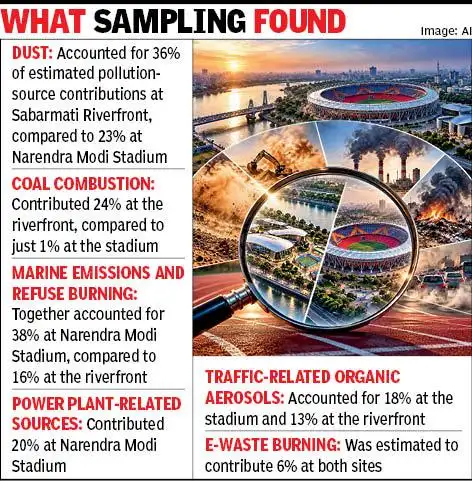
Gandhinagar: Even as authorities work on multiple fronts to prepare Ahmedabad to host the 2030 Commonwealth Games, air-quality sampling at two key venues has thrown up a concern: dust, coal combustion and waste burning are among the sources contributing to pollution around the proposed sporting hubs. The findings from Sabarmati Riverfront Sports Complex in Paldi and Narendra Modi Stadium in Motera reveal distinct pollution profiles at the two sites. marine emissions and refuse burning feature more prominently in the source profile at the stadium While dust and coal combustion account for a larger share of identified pollution sources at the riverfront.
Sampling at Sabarmati Riverfront was conducted from May 4 to 24, while monitoring at Narendra Modi Stadium took place from June 25 to Aug 8. Dust accounted for 36% of the estimated source contribution at the riverfront, compared with 23% at the stadium. Coal combustion showed a sharper contrast, contributing 24% at the riverfront against just 1% at Motera. Conversely, the combined category of marine emissions and refuse burning accounted for 38% at the stadium, more than double the 16% recorded at the riverfront. Power plant-related sources contributed 20% at the stadium. ahmedabad pollution maping The analysis also revealed differences in organic aerosol (OA) sources. Regional oxidised OA contributed 41% at the riverfront and 34% at the stadium, while oxidised solid fuel combustion OA accounted for 28% and 10%, respectively. Urban oxidised OA, however, had a higher share at the stadium, at 22%, against 13% at the riverfront. Traffic-related OA contributed 18% at Narendra Modi Stadium, compared with 13% at the riverfront. Solid fuel combustion OA also accounted for a higher share at Motera, at 16%, against 5% at the riverfront. Solid fuel combustion elemental sources contributed 14% at the riverfront and 11% at the stadium, while e-waste burning was estimated at 6% at both locations.
You Can Also Check: Gold Rate in Ahmedabad | Silver Rate in Ahmedabad | Bank Holidays in Ahmedabad | Public Holidays in Ahmedabad | Ahmedabad AQI | Weather in Ahmedabad | Petrol Price in Ahmedabad | Diesel Price in Ahmedabad | CNG Price in Ahmedabad | LPG Price in Ahmedabad Stay updated with the latest Ahmedabad news. The findings emerge from a new real-time air-quality monitoring initiative being undertaken by state govt and Ahmedabad Municipal Corporation (AMC), in collaboration with IIT Kanpur. The initiative, called SMART—VAYU (Sensing and Monitoring for Air-quality using Real-time Technology—Vision-based Ahmedabad air analYsis for Urban Management), aims to build a data-driven system to identify pollution hotspots and their sources across the city. Ten locations across Ahmedabad have been selected for the monitoring initiative. These include Sabarmati Riverfront Sports Complex, Narendra Modi Stadium, Gujarat Police Academy at Karai, Sanskardham, Veer Savarkar Sports Complex, Pirana AMC community service centre, Rakhial AMC health office, Vatva GIDC’s Chandrakala complex, Bopal urban health centre and Thaltej AMC ward office. Download the TOI App.