
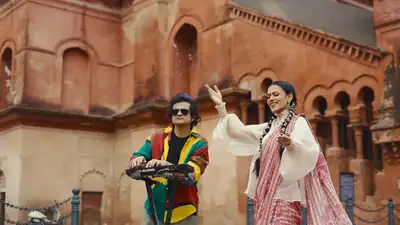
For Nirali Kartik, a Hindustani classical vocalist, and Karthik Shah, a composer and music producer, Maati Baani is where their shared love of music finds its home. What began fourteen years ago as a playful experiment with YouTube and digital platforms has blossomed into a genre all its own, one that weaves India’s folk and classical traditions together with funk, blues and contemporary sounds. Ahead of their Bengaluru performance Maati Baani Live: Fusion Beyond Borders , the duo reflect on their musical journey, the joy of discovering folk traditions, and their commitment to keeping their music open, curious and ever-evolving.
Nirali: We started it as an experiment. At the time, streaming platforms and YouTube were relatively new, and not many people were putting out original music. We wanted to play around with the new platforms and tools. Even being able to shoot our own videos and put them out was exciting. Karthik and I came from very different musical worlds, and Maati Baani became a space where we could make sense of both. We took it one song at a time, trying to do something new with every release that would make both us and our audience curious. Karthik: I am largely self-taught and come from the blues, funk, rock and experimental music space, while Nirali is a trained Hindustani classical musician who has been learning since she was five. We come from completely different spectrums, and that is what created the magic. My ideas would be to collaborate with an artist from Mongolia or somewhere in Europe, while Nirali would suggest going to Kutch to record folk musicians or working on classical songs. When these ideas came together, they created something interesting. Nirali: Our aim is to do it tastefully, not simply bring two genres together without knowing what we are presenting. We have tried, tested and loved the music ourselves before putting it out for our audience. Your Kannada folk song Tandanano has found listeners across platforms. What drew you to it? Karthik: AI is going to become prevalent in music, cinema and almost every other field. There is nothing we can do to stop it. But I believe that the more AI is pushed into art forms, the more people will want the real thing. If the medium gets saturated with AI-generated songs, people will eventually want to return to a folk song performed under a tree with real musicians. We humans will always want to connect with something that is more human. The question is how we use AI responsibly. If I use it, I would want it to assist me in what I am already doing rather than change my course and turn me into an AI-driven musician. Karthik: We have planned some of our most popular numbers, along with new songs that audiences may not have heard before. We will also perform Tandanano , Baawariya and Boondan . Folk musician Noor Mohammad Sodha, a Jodiya Pawa player from Kutch, will join us and play melodies on his rare instrument. It is going to be a fun evening, and we are very excited to perform in Bengaluru. Interestingly, our analytics show that Bengaluru is the city where our music is listened to the most.