
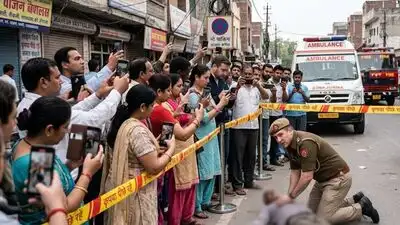
Recent incidents have highlighted the troubling behavior of bystanders who film emergencies rather than assisting(AI image used for representational purpose only)
In December 2025, two brothers, Farhan, 24, and Mohammad Kaif, 25, were travelling on a motorcycle on the Delhi-Dehradun Expressway when an unidentified vehicle hit them from behind. In August 2024, 32-year-old Prashant Kumar was riding his motorcycle near IPEM College when he was hit by another vehicle. For nearly 20 minutes, he remained on the road. The three incidents — in 2025, 2024 and 2023 — are different in their details.
People frequently hesitate to act due to confusion or the assumption that others will intervene. He suffered a serious head injury and lost a significant amount of blood. And that is perhaps what gets lost when an emergency becomes something to watch.
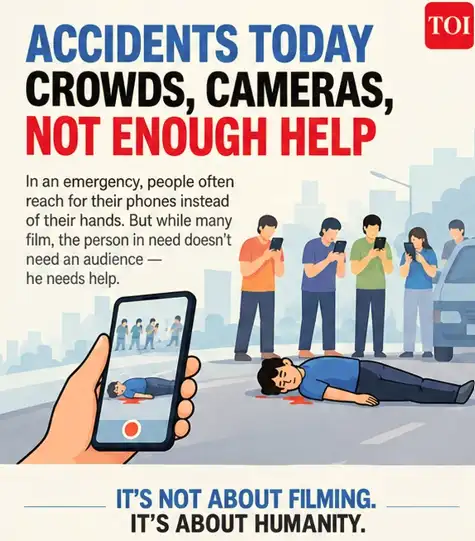
People can stop asking, “What should I do?” and start wondering, “What is happening? If an accident occurs, the initial reaction of people nowadays tends to involve taking out one’s smartphone. However, in the midst of filming, where is the person who needs help located? There is something very disconcerting about the manner in which public emergencies have come to unfold these days. An individual is lying injured in the middle of a road; crowds begin forming; spectators start looking. Soon, one person pulls out his phone; soon, several more follow. However, the individual on the ground did not need an audience. What he needed was some help. In no way does the above description intend to discourage using smartphones or even filming an incident in question. Sometimes a video can prove crucial as evidence or in clarifying the situation. There is simply a fundamental difference between filming an emergency situation with someone offering help and filming an emergency situation with nobody offering help. This becomes hard to overlook each time this pattern repeats itself: an accident, crowds gathering, taking out phones, and minutes going by until someone comes forward. Three emergencies over the course of the last three years illustrate this problem. The accident left both men injured. By the time traffic inspector Gopal Baisla and head constable Lal Singh reached the spot, a crowd had already gathered. There were witnesses. There were people looking at the injured men. There were people taking photographs and recording videos. The details of the incident leave behind an uncomfortable image: a crowd large enough to surround two injured people, but not necessarily large enough to produce one person willing to take responsibility. The policemen did not need to know every answer. They simply needed to recognise the urgency — and act. That distinction matters. In an emergency, helping does not always mean knowing exactly what to do. Sometimes it means being the first person to make a decision. It wasn’t necessary for the police officers to have all the answers. It was sufficient for them to recognize the urgency — and respond. This is crucial. During emergencies, providing help does not always involve knowing exactly how to respond. At times, it requires being the first one to make the call. People gathered around him. Some people recorded videos. Others discussed calling the police or an ambulance. But the help he needed did not immediately arrive. Traffic constable Sonu Singh eventually reached the scene. He tried to get people to arrange transport for Kumar, but nobody came forward. For a family, an incident like this is not a viral clip or a discussion about public behaviour. It is a person they knew and loved. A son. A friend. A colleague. Someone who was supposed to come home. The person at the centre of the scene becomes an image on a screen instead of a human being standing — or lying — in front of us. The consequences of this inaction can be severe, as illustrated by multiple fatal cases. The evolution of the smartphone has completely redefined the concept of being a witness. Before, a witness was a person who had seen what had happened. Nowadays, witnessing has become recording almost instantly. The phone is right there in our hands, and all we need to do is tap on the camera icon. Once something unusual happens, recording can become an immediate reaction. Another factor is the urge to use social media. One unusual event may result in recording it, posting it online and forwarding it within minutes. This has created an entirely new experience of public emergencies. Recording an incident can serve a legitimate purpose. Video footage can sometimes provide evidence, help establish a sequence of events or assist authorities. The issue is what happens before and during the recording. If someone is already calling for medical help and another person records from a safe distance, the situation is very different. If a crowd is filming while an injured person is bleeding on the road and nobody is even calling for assistance, the camera becomes part of a much more troubling picture. Before pressing the record button, there are a few simple questions worth asking: Is someone already helping? Has emergency assistance been called? Is it safe for me to intervene? Can I get someone who knows first aid or someone in authority? Will my recording genuinely help, or am I simply documenting someone’s suffering? The answers will not always be obvious. But asking the questions can interrupt the automatic impulse to simply watch. Perhaps one reason people hesitate is that they imagine helping as something dramatic. They think they need to lift the injured person, perform first aid, confront someone or know exactly what to do. But helping can be much simpler. It can mean: Calling emergency services. Alerting the police or nearby security personnel. Asking a specific person to make the call rather than simply shouting, “Someone call an ambulance. Keeping traffic away from an injured person. Finding someone trained in first aid. “I will find the police. Explicit instructions can transform the passive crowd into an active crowd. Not only does it give the instructions what to do, but it also eliminates the ambiguity of who is responsible for it. This may be the bigger question. Our phones allow us to capture almost everything: an accident, a fight, a collapse, a fire or a public disturbance. Within seconds, there can be a record of the event. But being able to capture something is not the same as being able to respond to it. A society can become extremely good at documenting tragedy without becoming any better at preventing suffering. That is where the uncomfortable contradiction lies. We may know how to record an emergency in high definition. We may know how to upload it instantly. We may know how to share it with thousands of people. But in that first crucial moment, the person in front of us may need something far more basic: A call. A helping hand. A little space. A voice saying, “I’m here. Help is coming. Focusing on helping instead of recording could prevent tragic outcomes for victims. The locations are different. The people are different. The circumstances are different. But the question running through all of them is remarkably similar: What if the emergency occurs before a crowd but none of the members is willing to help first? Maybe it is not true that they suddenly became indifferent. Perhaps some of them are afraid. Perhaps others are confused. Some are just uncertain how to help. Some think that someone else will step up to the task. And indeed, there may also be those who care more about recording the situation than offering any assistance. The causes of human behavior are rarely singular. However, knowing the causes will certainly not make us accept the result. Make way for the injured individual. Make room for the helpers. And always remember that there is a human being involved in this incident.
A year earlier, a similar scene unfolded in Ghaziabad.
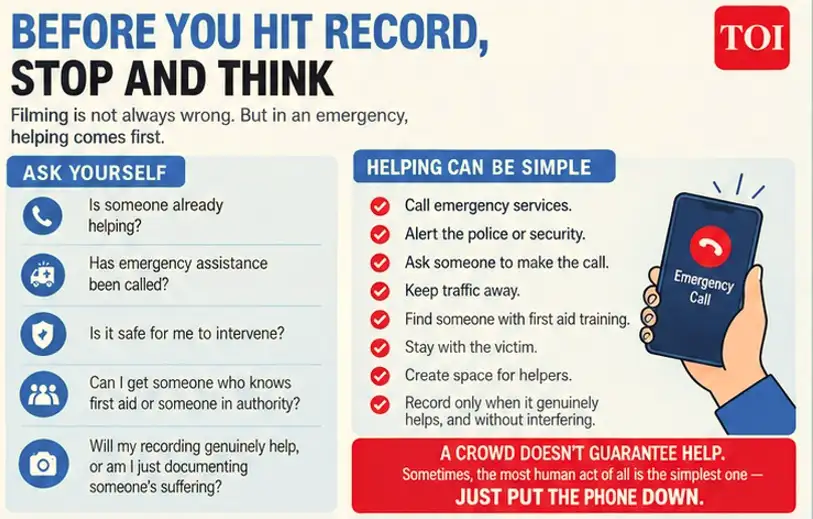
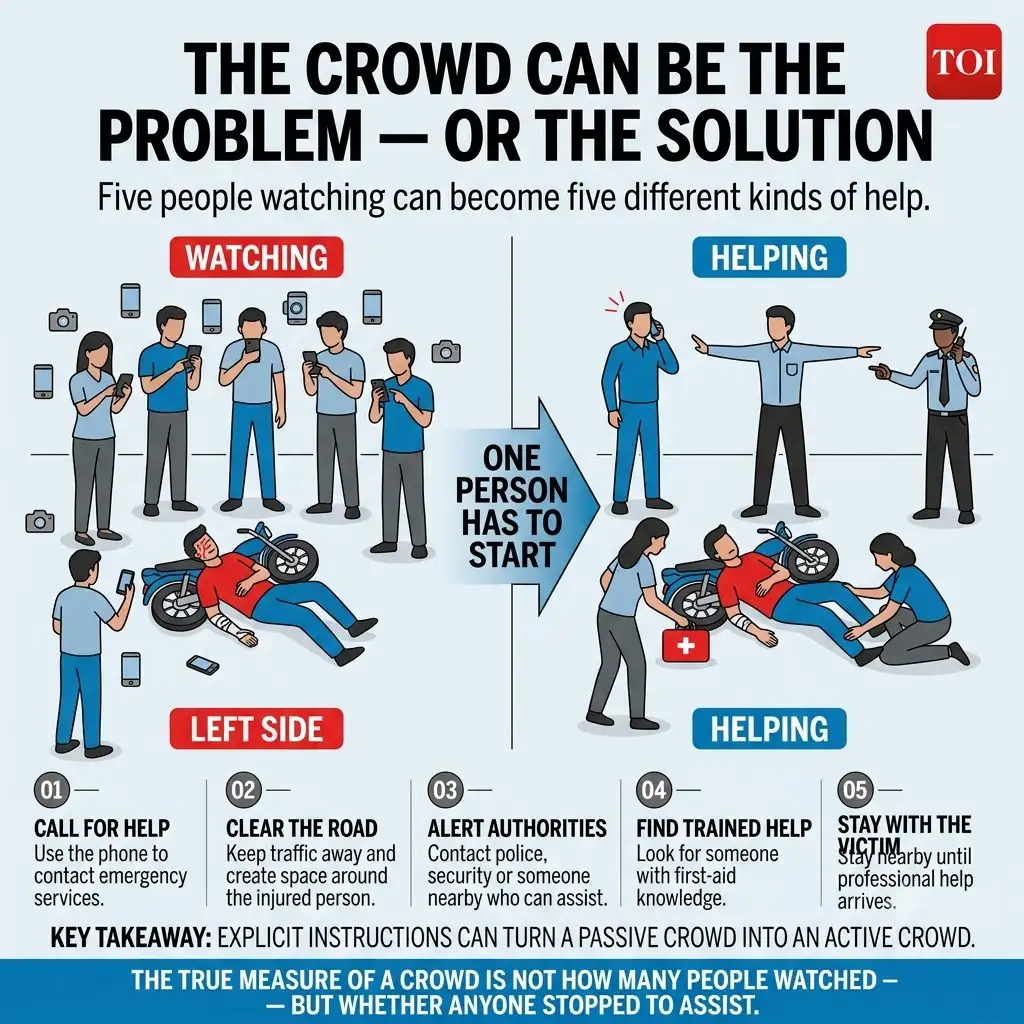
“You stay with him.” Staying beside the victim until professional help arrives. Helping create space instead of adding to the crowd. Recording only when there is a genuine reason for the footage and doing so without interfering with assistance. There is a critical distinction between having the ability to save someone and helping someone. Most people would not be able to carry out a medical rescue operation. However, virtually everyone can spot that someone requires help and be able to start helping. A crowd does not mean something negative by definition. On the contrary, a number of people could be extremely helpful in a situation of an emergency. One could call for help; another direct traffic; another find a doctor; still another stay with the victim; and yet another guide the ambulance to the scene. The same five people who would otherwise just stand there watching could become five kinds of help in different ways. What makes the difference is the initiative. Somebody should start the ball rolling. Someone has to say: “You call the ambulance. “You clear the traffic.
Because filming itself is not always wrong, the distinction matters. Because responsibility is shared across the group, simply put, when many people are present during an emergency, individuals can feel less personally responsible for intervening. Because in the meantime while the crowd deliberates, the person in front of them waits. Because the true measure of a crowd is not the number of people who have observed what has occurred.
Sometimes, the most human act of all is the simplest one: You Can Also Check: Gold Rate in Delhi | Silver Rate in Delhi | Bank Holidays in Delhi | Public Holidays in Delhi | Delhi AQI | Weather in Delhi | Petrol Price in Delhi | Diesel Price in Delhi | CNG Price in Delhi | LPG Price in Delhi Stay updated with the latest Delhi news. A recording can sometimes provide evidence or help clarify what happened. The concern is when reaching for the camera becomes an automatic response before anyone considers the person at the centre of the emergency. There is something in psychology known as the bystander effect . If there are ten people around, each person may assume that one of the other nine will take charge. This can create a strange cycle. One person waits. The second person sees the first person waiting. The third person sees both of them waiting. Soon, an entire crowd can be standing still. No one necessarily decided that the injured person did not deserve help. No one necessarily intended to be cruel. People may be frightened, confused, uncertain about what to do, or simply assume that someone else has the situation under control. But collective hesitation can still have serious consequences. That is why the presence of a crowd does not always guarantee help. Sometimes, what is missing is not another witness, but the first person willing to take responsibility. Not necessarily. This distinction is important. And there is something that a smartphone will never do by itself: It will never care. This decision can only be made by the owner. In future emergencies, maybe the first reaction should be slightly different. Before taking out the camera, observe the individual. Before filming, scan the surroundings. Ask: “Is anybody assisting? And if the response is negative, the cell phone can always be of some use. Utilize it to make calls. Utilize it to send out alerts. Utilize it to locate assistance. Utilize it to connect the individual to somebody who can help. But if somebody is doing this already, take a step back. It is not the number of films that have been made. It is not even the speed with which the film has been distributed on social media. It is actually far simpler than that: When everybody saw somebody in need of help, was there anybody who stopped to assist? Download the TOI App.
They reached the hospital in 17 minutes. In November 2023, Delhi filmmaker Piyush Pal, 30, was involved in a motorcycle collision on the Outer Ring Road.
A doctor later said that Kumar could have died without timely treatment. But there was no immediate rush to get the victims to a hospital. One of the brothers had suffered severe head injuries and was barely conscious. The two policemen eventually took charge. Rather than waiting for the situation to sort itself out, they moved the injured men into their PCR vehicle and rushed them to a hospital. He finally stopped an autorickshaw himself, moved Kumar into it and took him to hospital. Twenty minutes may not sound like a long time in an ordinary situation. On a normal afternoon, twenty minutes can disappear while waiting for a cup of coffee, scrolling through social media or sitting in traffic. For someone suffering a serious head injury and bleeding on a road, those same twenty minutes can carry a completely different meaning. This is where the question about filming becomes more complicated. Was every person holding a phone deliberately choosing not to help? We cannot know that. Some may have been frightened. Some may not have known what to do. Some may have assumed someone else had already called for help. But the result was the same: a crowd was present, yet the responsibility for immediate action eventually fell on one person. He suffered severe head and facial injuries and lay bleeding on the road. The scene that followed is perhaps the most difficult of the three to forget. People gathered around him. Some were recording videos. Some were taking selfies. But help did not come immediately. Pal remained there for around half an hour before people finally stepped in to get him medical attention. He was taken first to a nearby clinic and later shifted to PSRI Hospital. By then, around two hours had passed since the accident. Pal died from his injuries. His mobile phone and laptop were also stolen while he was lying injured.