
What does it take to build a happier society? That was the central question at the Festival of Joy, which brought together voices from mental health, neuroscience, education, business, design and wellbeing.
The many faces of mental health Mental health advocate Ira Khan spoke about her own experience with depression — when she slept for long hours, struggled to eat and lost trust in herself. You Can Also Check: Gold Rate in Bengaluru | Silver Rate in Bengaluru | Bank Holidays in Bengaluru | Public Holidays in Bengaluru | Bengaluru AQI | Weather in Bengaluru | Petrol Price in Bengaluru | Diesel Price in Bengaluru | CNG Price in Bengaluru | LPG Price in Bengaluru Stay updated with the latest Bengaluru news.
“This is not a summit where professionals talk about mental health issues, but rather find a way to bring more joy into our everyday lives,” she said, adding that a developed India “can’t just be about GDP, infrastructure, global rankings alone… it also has to be about how people show up in life and work. “Mental health is not the same as mental illness,” she said, adding that support needs to extend beyond clinicians to teachers, managers, researchers, policymakers, community workers and counsellors. Comparing the brain to a Ferrari, she said poor sleep, worry, comparison and overthinking are like “feeding kerosene” to it. “If two or three kids stay in one room, they will talk to each other,” he said. “Games not only teach us how to succeed but also to be magnanimous when we lose,” Debabrata said. Sitharaman argued that “wellbeing should not be another class between 3pm and 4pm” but “a part of the university itself. “Use sound as a tool to focus your mind on one thing,” he said.
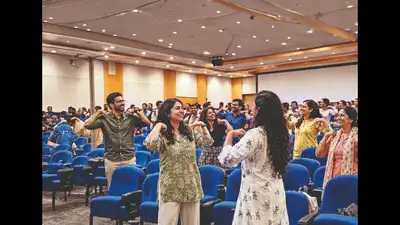
Conceived by Richa Singh, co-founder of YourDost, the festival moved past conversations on mental illness to explore the everyday factors that shape how people live, work, learn, connect and cope. Sessions touched on personal stories of depression, how workplaces and universities can foster care, the neuroscience of wellbeing, and hands-on experiences in sound healing, Tai Chi, Kintsugi and doodling. The common thread: wellbeing cannot be something we think about only when something goes wrong. Not Just mental health But a movement for joy For Richa, the festival came from a wish to shift focus from mental health concerns to everyday wellbeing. Therapy helped, but it also pushed her to think about mental health beyond clinical care. Shedding light on the influence each person has on those around them, she added, “You are already shaping someone’s mental health, whether you like it or not. A different way to think about the brain Neurologist Dr Sweta Adatia drew on her own experience to explain the connection between emotions and the brain. During a difficult period in her life, she underwent a brain scan. It was a turning point that pushed her towards meditation, breathing, nutrition and other aspects of wellbeing. Her approach to wellbeing is summed up in the word JOY: “J for just breathe, O for open your mind and Y for yield to the present. Can colleges build better human beings? A panel featuring IISc Bengaluru professor and former IIT Guwahati director TG Sitharaman and IIIT Bengaluru professor Debabrata Das explored how universities can make greater space for wellbeing. Talking about the impact of technology and academic pressure on students’ lives, Debabrata cited IIT Guwahati’s shift to triple-sharing hostel rooms. Sports came up as another way to learn to handle both failure and success. What does a caring workplace look like? SV Nathan, Chief Talent Officer at Deloitte India, noted that real care sometimes means institutions “ought to break some rules. Aruna C Newton, Vice President at Infosys, added, “A caring organisation is one which demonstrates that care through the decisions that it makes. Beyond the talks: Sound, movement and craft Sound healer Darshan Bhagwat used Himalayan singing bowls, chimes, bells, drums and other instruments to help participants step away from the constant stream of thoughts. He stressed that sound healing should complement, not replace, therapy. Tai Chi Master Krishna Kumar led participants through slow, meditative movements, and added, “Slowing down can help people notice their bodies, surroundings and thoughts more closely. The festival also made room for creativity and play. A doodling session invited participants to use simple shapes, movement and expression to create moments of laughter and connection. A Kintsugi workshop, led by Payal Kedia, focused on the Japanese art of repairing broken objects using cracks as a metaphor for imperfection, resilience and renewal. It explored the idea that wellbeing may be less about becoming whole again and more about accepting the experiences that shape us. Download the TOI App.