
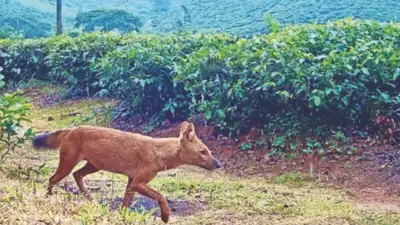
Camera-trap image of a dhole amid the tea plantations in Valparai
In Valparai, an informant network established during the research helped scientists locate dhole packs and record more than 30 hours of footage documenting their behaviour.
The first study, titled “Local Ecological Knowledge offers opportunities to study and monitor elusive carnivores in coexistence landscapes”, was based on 476 interviews with local residents, plantation workers and forest department personnel across Wayanad and Valparai. Many respondents said dholes tended to avoid people. The second study, titled “The hunting god: Vernacular knowledge on Asiatic wild dogs (Cuon alpinus) blends ecological insights with folklore in a shared agroforest landscape of India’s Western Ghats”, examined the relationship between communities and dholes in Valparai through interviews with 89 people, including residents of tribal settlements and plantation workers. In several tribal communities, dholes are known as “Vettaikara Apichi”, loosely translated as “hunting gods”.
The findings also offered insights into how dholes share space with people. Interactions between the animals and people were common in tea plantations, but reports of livestock attacks were extremely rare. One of the study’s notable findings was the cultural significance of the animals. Researchers documented associations between dholes and forest deities, rituals, prayers, songs and oral traditions. Some stories portrayed them as protectors or as kin to people and domestic dogs.