
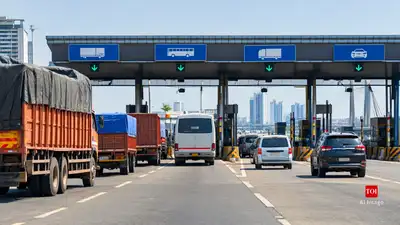
Mumbai has increased its entry toll, affecting various commercial vehicles crossing city entry points (AI-generated image used for representational purposes)
MUMBAI: The increase in Mumbai’s entry toll may look modest at Rs 15 to Rs 35 per trip, but for commercial vehicles making repeated trips across the city’s five entry points, the additional cost can add up to thousands of rupees a month, a burden transporters say could eventually find its way into freight rates and consumer prices. From Thursday, mini buses and light commercial vehicles (LCVs) pay Rs 90 per trip, against Rs 75 earlier; trucks and buses Rs 180 against Rs 150; and heavy motor vehicles Rs 225 against Rs 190. Private cars and SUVs, school buses and state transport buses remain exempt under the October 14, 2024 notification. The extension was approved after the state waived tolls for specified light vehicles, school buses and state transport buses from October 14, 2024, with compensation to MSRDC under its contractual obligations with the toll operator.
Because the toll concession at the five entry points has been extended beyond its earlier November 2026 end date to September 17, 2029, the financial impact is particularly relevant. The revised rates apply at Vashi, Airoli, Dahisar and the two Mulund entry points. But there is another important provision
From November 19, 2026, until September 17, 2029, MSRDC has been directed to maintain and make available to the government real-time vehicle-count data by category at these toll points. The state cabinet had also approved continued maintenance and upkeep of 27 flyovers and associated structures in Mumbai and its suburbs by the private contractor. Separately, it approved staggered cash compensation of Rs 775.58 crore to MSRDC, equivalent to the estimated cost of the proposed Vashi Creek Bridge No 3, in lieu of toll revenue foregone on the Vashi Creek Bridge. The toll collection system at the five entry points dates back to September 2002. Mumbai Entry Points Ltd had made an upfront payment of Rs 2,100 crore towards capital expenditure incurred by MSRDC, with the tolling rights intended to recover the investment and associated financing, administration, operations and maintenance costs.
For Mumbaikars, therefore, the immediate takeaway is simple: the private car toll remains zero, but the cost of bringing goods into the city has gone up, and the government will now have three years of category-wise traffic data to show who is actually bearing the toll burden. You Can Also Check: Gold Rate in Mumbai | Silver Rate in Mumbai | Bank Holidays in Mumbai | Public Holidays in Mumbai | Mumbai AQI | Weather in Mumbai | Petrol Price in Mumbai | Diesel Price in Mumbai | CNG Price in Mumbai | LPG Price in Mumbai Stay updated with the latest Mumbai news. This could provide a clearer basis for assessing the actual traffic mix and toll revenue during the extended concession period. Under the concession arrangement, toll rates are revised every three years. Transporters have opposed the latest increase, arguing that higher tolls add to operating costs and can translate into higher freight charges. AIMTC has also sought toll exemption for heavy commercial vehicles. Download the TOI App.
For a commercial vehicle crossing a toll point once each way on 26 working days, the monthly impact of Thursday’s hike works out to about Rs 780 for an LCV, Rs 1,560 for a truck/bus and Rs 1,820 for a heavy motor vehicle. These are illustrative calculations and do not include additional trips.