Real estate dynamics in Mumbai’s BMC regions illustrate varying demand across price categories (Representative image)
MUMBAI: The cooling in real estate segment in BMC areas has carried on into 2026. By the end of the Sept quarter, 32,437 units had been recorded for the year. Properties priced above Rs 2 crore have shown consistent growth and have continued to gain share even during periods when broader market volumes cooled.
Because the above-Rs 2 crore category did not show the same dip seen elsewhere, liases Foras highlighted that the Sept quarter of 2026 stood out. The divergence suggests that affluent end-users and investors remain active in the market, and that buyers in these segments are less sensitive to shifts in borrowing conditions or short-term macroeconomic volatility.
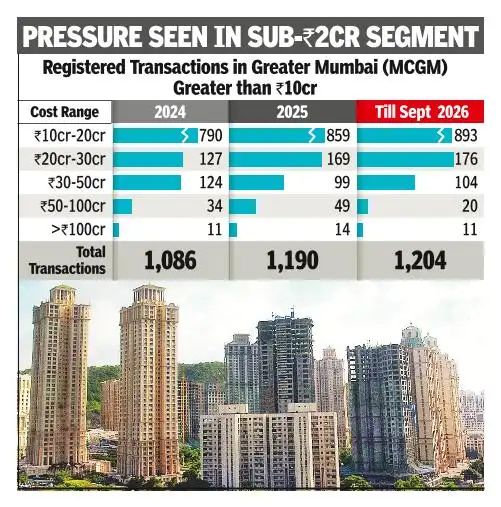
The pressure is most visible in the sub-Rs 2 crore category, which historically contributes a large share of Mumbai’s residential unit sales. At the 2024 peak, the below-Rs 2 crore segment accounted for roughly 30,000 units. In 2025, this segment contracted by around 8%, signalling that affordability constraints and buyer fatigue are most pronounced at the entry and mid-market levels. This softness has continued through 2026. The segment has recorded about 16,904 units so far this year, pointing to a materially weaker pace compared with the 2024 high. Figures from Inspector General of Registration show transactions above Rs 10 crore have risen steadily over the past three years, without any year recording a decline in this bracket. The Rs 10 crore to Rs 20 crore band is the most active and represents close to 74% of all transactions above Rs 10 crore, indicating that the centre of gravity for ultra-luxury demand lies in the lower end of the very-high-value segment rather than in sporadic trophy purchases. Beyond this dominant band, about 15% of transactions are in the Rs 20-30 crore range, around 9% fall between Rs 30 crore and Rs 50 crore, and about 2% are in the Rs 50 crore to Rs 100 crore bracket. Roughly 1% of transactions exceed Rs 100 crore, with 11 such deals recorded, according to the data cited. The breakdown suggests while marquee purchases continue to take place, the ultra-luxury market’s strength is being sustained primarily by depth and repeat activity in the Rs 10-20 crore segment. With the stock market correcting about 15% from its peak, he said the pool of investors with large realised gains- and the related incentive to reinvest in premium housing-could shrink.
“We therefore expect luxury demand to moderate, both in Greater Mumbai and across other major Indian markets. You Can Also Check: Gold Rate in Mumbai | Silver Rate in Mumbai | Bank Holidays in Mumbai | Public Holidays in Mumbai | Mumbai AQI | Weather in Mumbai | Petrol Price in Mumbai | Diesel Price in Mumbai | CNG Price in Mumbai | LPG Price in Mumbai Stay updated with the latest Mumbai news.
Liases Foras said the slowdown is not evenly distributed across price bands. Pankaj Kapoor , MD of Liases Foras, said the luxury market’s growth over the past several years has been particularly pronounced in the post-pandemic period, but he cautioned the segment may now be nearing a plateau. However, it now appears to be approaching a plateau,” he said. He said some buyers monetised equity market gains and redeployed proceeds into real estate, in part to optimise capital gains tax outcomes.
the data suggests the market is operating near its upper limit on volume, with limited headroom for further increases While industry participants expect the final quarter to get support from the festive season. The reduced run rate underscores the extent to which demand is being tested in the mass-market portion of the city’s housing pipeline, particularly as prices remain elevated and households weigh purchasing decisions more cautiously. Pressure see in sub-Rs 2cr segment In contrast, higher-priced homes have continued to expand. Registration data supports the trend. The distribution of these ultra-luxury deals also shows a clear pattern. “The luxury housing market has seen impressive growth over the past four to five years, particularly in the post-Covid period. Kapoor attributed a porti-on of recent demand to investor behaviour linked to gains in financial markets. The exceptional gr-owth of the post-pandemic years may be difficult to sustain. Download the TOI App.