
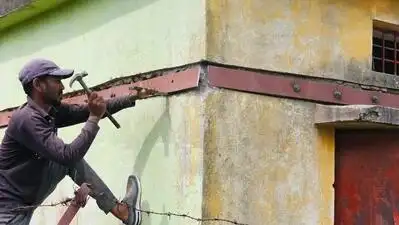
STABLE technology used to make a ZP school situated in earthquake-prone area from rural Hingoli safer
Chhatrapati Sambhajinagar: In a district rattled by 17 earthquakes in less than a year, a school in Pangra Shinde village has become the testing ground for a technology designed to stop buildings from falling apart when the earth shakes.
“Retrofitting of the primary school at Pangra Shinde village in Basmath taluka has been completed using the technology,” district collector Rahul Gupta said, adding that the experiment has offered an effective option for strengthening unsafe buildings in earthquake-prone areas. Engineers have retrofitted the structure with steel bands that bind its walls together, helping it withstand seismic shocks. STABLE (Steel Twin Lintel Band) technology, developed by CSIR-CBRI, Roorkee, effectively locks a building’s walls together, helping it withstand earthquake shocks without major structural damage.
Hingoli has recorded as many as 17 earthquakes in just under 12 months, according to official data, making the Marathwada district one of the most seismically active zones in the country. Stay updated with the latest Chhatrapati Sambhajinagar news.
This gives a monolithic and strong support to the walls of the building and helps to keep the wall-to-wall connection strong during an earthquake,” Gupta said. The collector said the strengthening of old buildings can be done at low cost and in less time with STABLE technology. The pilot experiment at Pangra Shinde has paved the way for use of this technology for strengthening other unsafe buildings in the district as well as in Maharashtra in future,” he said.
“Under STABLE technology, steel strips are installed on both inner and outer sides of the building walls at lintel level. These strips are connected to each other with the help of through-bolts. As part of the application of STABLE technology, the school building was inspected and its lintel level determined before plaster was removed at required locations. Holes were drilled into the walls, and steel strips were installed on the inner and outer sides. The strips were secured using through-bolts, washers and double nuts. Cement grouting filled vacant spaces. Steel angles were installed and welded at the building’s corners to strengthen connections between walls in two directions. Anti-rust coating and paint were then applied. “It can prove useful for structural safety of unsafe old schools and other buildings. Before actual implementation of the modern technology, special training was imparted to local engineers in Hingoli by experts from CSIR-CBRI. Guidance was also given on technical assessment of old buildings and retrofitting methods. A team from the National Centre for Seismology (NCS) is scheduled to visit Hingoli to conduct a comprehensive scientific study of the recurring low-to-moderate intensity earthquake swarms and fault line activities in the region. Download the TOI App.