
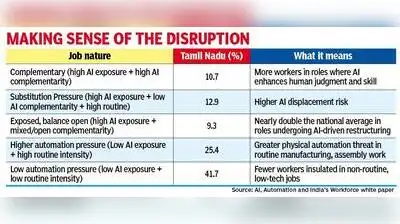
Tamil Nadu has a higher share of jobs with complementary effects from AI at 10.7%
Tamil Nadu has a higher share of jobs with complementary effects from AI at 10.7% (the 4th highest among the large states), compared with India’s average of 7.6%, according to a research paper by the Great Lakes Institute of Management’s Centre for Finance and Economics Research. Tamil Nadu also has 12.9% of jobs under substitution pressure from AI, above the country’s 11.4%. At 25.4%, TN has higher automation pressure, which indicates conventional automation in jobs such as garment workers and machine operators, compared to 21% nationally. TN also has 38.3% of employment in high-routine occupations (fourth highest), which includes routine AI-exposed jobs and low AI-exposed conventional jobs. TN is above the national average here too (25.4% against 21.0%), driven by construction and manufacturing labourers, garment and food-processing workers and machine operators. Since 2011-12, the share of roles at risk of substitution rose from 9.5% to 12.9%, and automation pressure rose from 23% to 25.4% in Tamil Nadu.
AI substitution pressure in TN is above average due to a large retail and clerical workforce, with sales workers forming 9.5% of employment and clerks 3.4%. Because entry-level jobs are where both AI and automation pressure hit first, second, prepare the young,. You Can Also Check: Gold Rate in Chennai | Silver Rate in Chennai | Bank Holidays in Chennai | Public Holidays in Chennai | Chennai AQI | Weather in Chennai | Petrol Price in Chennai | Diesel Price in Chennai | CNG Price in Chennai | LPG Price in Chennai Stay updated with the latest Chennai news.
Prof Vidya Mahambare, director of research at Great Lakes and co-author of the paper, said TN’s higher complementarity comes from having more teachers, healthcare, legal and social professionals. A higher share of healthcare professionals, engineering, R&D, professional services, and management of organised services is the reason for TN’s higher AI complementarity. ” “Health professionals have the highest complementarity of any occupation. Chennai’s position as a medical hub, R&D roles in automotive, electronics and global capability centres (GCCs), professional services, and managers of organised services such as hospitality, retail and logistics add to this,” she said. Vivek Jadhav, co-author and assistant professor at the Institute of Management Technology (IMT), Ghaziabad, said TN has one of the strongest bases in the country to benefit from AI. “In IT and GCCs, entry-level coding, testing and support face the most direct AI pressure, while design, AI integration and client-facing roles grow, so the hit falls mainly on fresh graduates,” he said. Mahambare said, “The pressure comes from AI and software in billing, data entry, and customer handling. It depends on cost, she said, adding that demographic ageing and labour shortages will drive automation out of economic necessity. Jadhav said in autos and components around Chennai and Hosur, the big plants are already highly automated, so the next shift will come in small and medium suppliers, pushed by quality needs and labour shortages. On policy suggestions, he said TN can build on the complementary base.
A new study suggests that AI could benefit Tamil Nadu ’s labour market, with a higher share of jobs in sectors where workers are expected to gain productivity from AI. But it could be a double-edged sword. the state also has a higher share of roles at risk of replacement (substitution pressure) from AI and traditional industrial automation While promising complementary benefits. “The common factor for complementarity is work where a qualified person must take responsibility for the outcome, so AI supports the decision but does not replace the person making it. In factory-floor automation, the pressure is from conventional machines. A higher share of high-routine occupations does not mean these jobs will disappear. “Health, education and engineering already employ a larger share of workers in TN than nationally, so AI tools and training there will bring the quickest productivity gains. Our educated youth need judgement, problem-solving and client skills alongside technical ones, not just familiarity with AI tools. Download the TOI App.