
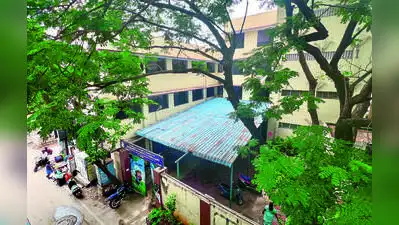
At the Greater Chennai corporation middle school in Tondiarpet, all available outdoor space has been converted into a parking area
In more than 28 years as a govt school physical education (PE) teacher, S Pushparaj has not had a single promotion or pay hike.
The job often costs him money, he says. “Sometimes I pay the auto fare to bring children from interior villages to competitions,” he says. Pushparaj finds grounds for his students to play at, raises funds so they can train. Colleges too, are losing ground. The state govt recently proposed a memorial for TVK’s five ideological leaders (Rani Velu Nachiyar, Periyar E V Ramasamy, B R Ambedkar, Anjalai Ammal and K Kamaraj) at University Union grounds. Teachers and students have opposed the move as the ground is shared by University of Madras-affiliated colleges for sports training and meets.
PE relies on common PTA funds,” he says. “Students are given two compulsory periods for physical education,” says Gopalakrishnan, the state’s chief inspector of physical education. The result is that students who cannot access school grounds are left dependent on external facilities. Those who can afford it can train at sports clubs run by federations, while students in villages or from low-income families practise wherever they find space. It is no longer the case. But the govt is on the defensive. “There are playgrounds for them to play and necessary equipment is provided. Appointment of PE teachers is a govt decision based on school requirements. What more can the govt do?”
“Earlier there was a system of collecting a separate PE fee at schools.
At the Tamil Nadu Physical Education and Sports University, we are asked to pay `30,000 a day when we take govt school students to train.
“If this happens, no one will be able to access the ground for training,” says Pushparaj, president of the Chengalpet district handball association. “We are usually roped in to monitoring students and maintaining discipline and do other administrative jobs,” says S Arockia Das, a govt school PE teacher. Sankaraperumal says while most schools don’t have PE teachers, even where they are appointed, staffing is not adequate. “A high or higher secondary school with 700 students generally has only one PE teacher, with a second teacher coming only when the strength exceeds 700,” he says. “Most primary and middle schools do not have playgrounds and even among matriculation schools, 70% lack them.”
“We approach institutions to access their facilities to train students for tournaments. PE teachers at govt schools say they are merely a ‘title’, frequently assigned work that has nothing to do with their subject. “In some schools, my colleagues double up as watchmen, office assistants or clerks. Our primary role becomes assisting the headmaster with administrative work. When we get hired at a school, our duties get reduced to doing whatever work we are assigned, rather than teaching physical education.