
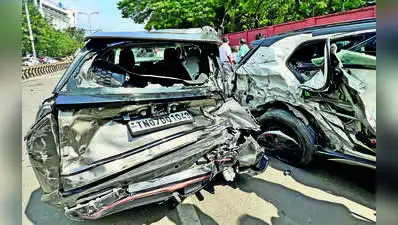
Chennai reported 402 deaths between January and October, down from 420 a year earlier. Injuries fell to 2,865 from 2,997
Chennai: About 53 people died on Tamil Nadu ’s roads every day in the first nine months of 2026, but Chennai bucked the trend and recorded a decline in road deaths through October. The city reported 402 deaths between January and October, down from 420 a year earlier. Injuries fell to 2,865 from 2,997. Between June and August, 1.17 lakh two-wheeler riders were booked for helmet violations. Compliance has now reached nearly 95% among riders but remains at 50% among pillion passengers. Through September, Tamil Nadu recorded 56,602 crashes and 14,373 deaths, according to its road safety analysis — roughly 207 crashes and 53 deaths a day. In 2025, the averages were 195 crashes and 51 deaths a day. Between January and June 2026, the state averaged 206 crashes a day, with the total nearly 6% higher than in the same period of 2025. But the daily average rose to 210 between July and September. Tamil Nadu has about 4.1 crore registered vehicles. Between 2022 and 2025, vehicle numbers grew 17%, crashes 11% and deaths 3.5%. Authorities suspended 41,402 licences in six months, compared with 95,568 throughout 2025, according to State Crime Records Bureau figures. Drunken-driving licence suspensions reached 61% of the previous year’s total. Beyond the Highways National highways make up less than 3% of the state’s road network but accounted for 31% of crashes in 2025. “Nearly 70% of crashes happen away from national highways. Other district roads accounted for 32% of crashes, major district roads 19% and rural roads 12%. The state has identified 7,723 hotspots and completed 5,356 interventions, leaving 2,367 awaiting action. The state also plans to pilot Vizhi, which uses dashboard cameras and artificial intelligence to flag traffic violations, in 100 enforcement vehicles before expanding statewide. Faster Response, Persistent Delays The health department has expanded ambulance services, upgraded emergency rooms and provided treatment cover of up to Rs 2 lakh for road accident victims. More than 700 government and empanelled private hospitals offer free care for the first 48 hours.
“Greater enforcement against helmet violations, drunken driving and speeding, along with improvements at accident-prone locations, contributed to the reduction,” said P Pakalavan, joint commissioner of police for traffic, South. Prevention Falls Behind The figures expose a gap between preventing crashes and treating their victims, experts said. We must urgently do something to improve road safety behaviour,” said Venkatesh Balasubramanian, an IIT Madras scientist. It may not be right to say only speeding on wide, good-quality roads kills,” said transport commissioner Sigy Thomas Vaidhyan. “We have told police to investigate locations with at least three crashes, including those without injuries or deaths,” Vaidhyan said. “Ambulances are positioned near crash hotspots and reach scenes within 10 minutes of receiving calls,” health secretary Darez Ahamed said.
Police used number plate recognition cameras, speed radars and interceptor vehicles to identify offenders, while civic agencies closed unsafe median openings and improved lighting and signs. Statewide, the picture was grimmer. Police attributed the increase to personnel being diverted to election duty. “With the rise in vehicle population, violations have increased drastically, leading to accidents and injuries. Multidepartment teams will assess proposed remedies, such as rumble strips, streetlights and traffic signals, before implementing them. ThiranAI, a companion programme, will provide adaptive, game-based training for new drivers and refresher courses for offenders. The plan sets a two-year timeline for these and other measures. Crews alert hospitals to patients’ conditions before arrival so triage and treatment can begin promptly.
Ambulances can take 20 to 30 minutes to transport patients in remote areas and heavy-traffic zones, according to EMRI data. We must have at least two or three in every district,” said a senior government doctor. (inputs from Ram M Sundaram) You Can Also Check: Gold Rate in Chennai | Silver Rate in Chennai | Bank Holidays in Chennai | Public Holidays in Chennai | Chennai AQI | Weather in Chennai | Petrol Price in Chennai | Diesel Price in Chennai | CNG Price in Chennai | LPG Price in Chennai Stay updated with the latest Chennai news.
So, in severe cases, delays in reaching a tertiary care centre can lead to fatalities,” said M Selvakumar, head of EMRI, Tamil Nadu. Reaching a hospital can take longer. “Ambulances don’t have the facility to intubate. Emergency doctors say districts still need more Emergency Care and Recovery Centres. “They work like hubs, stabilising patients before sending them to the nearest healthcare facility for better treatment. Download the TOI App.