
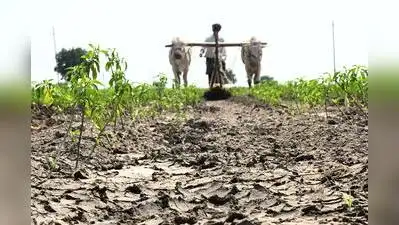
Hyderabad : Facing one of its worst monsoon shortfalls in recent years, the Telangana govt on Tuesday declared 365 mandals across 31 districts drought-affected, citing deficient rainfall, prolonged dry spells, shrinking crop acreage and critically low reservoir storage.
Of these, 111 mandals were categorised as severely drought-hit and 254 as moderately affected, triggering relief measures and a request for central assistance. Among the affected districts, Nalgonda and Sangareddy topped the list with 28 drought-hit mandals each, followed by Suryapet (23), Adilabad and Vikarabad (20 each), Nizamabad and Rangareddy (18 each), and Yadadri-Bhuvanagiri and Khammam (17 each). “The state had received 615 mm as against the normal rainfall 740 mm with a deviation 17% deficit between June 1 to Sept 30 monsoon with 18 of 33 districts in deficit kharif crop areas reduced from 139 lakh acres to 126 lakh acres. Paddy area reduced by 18% from 69 lakh acres to 57 lakh acres and currently live storage in major and medium reservoirs have water reserves at 179 tmc against 589 tmc capacity raising risks to drinking water, agriculture, livestock and power,” the govt said.
The declaration follows a scientific assessment of rainfall, crop conditions, soil moisture, groundwater levels, and field verification surveys conducted across the state. The govt attributed the drought conditions to El Niño effects, weak low pressure systems over the Bay of Bengal and prolonged dry spells during the southwest monsoon season. Manoharabad was the lone drought-affected mandal in Medak district. Interestingly, even Mulugu district, which received heavy rainfall in parts, had four mandals declared drought-hit.
“The rainfall data between June 1 to Sept 30 and dry spell logs were evaluated for the mandatory trigger I assessment and also evaluated impact indicators such as agriculture shortfall, remote sensing, soil moisture, ground water. In mandals with more than 75% irrigated area, ground truthing sample surveys were conducted in 10% of the villages of each of the mandal and the findings of field verification have been taken as the final basis for the intensity of drought,” the GO said.
Drought classification was based on a multi-criteria assessment covering rainfall deficiency, dry-spell intensity, crop stress, remote-sensing data, soil moisture, and groundwater conditions, according to the GO. You Can Also Check: Gold Rate in Hyderabad | Silver Rate in Hyderabad | Bank Holidays in Hyderabad | Public Holidays in Hyderabad | Hyderabad AQI | Weather in Hyderabad | Petrol Price in Hyderabad | Diesel Price in Hyderabad | CNG Price in Hyderabad | LPG Price in Hyderabad