
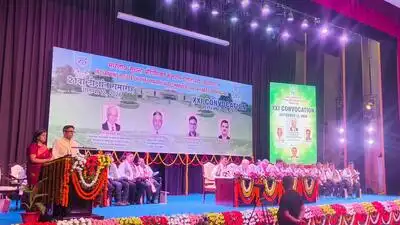
The 21st convocation of IIIT-A was held on Saturday wherein 728 students received their degrees and 22 medals were awarded
Director Prof Mukul Sharad Sutaone said the institute had introduced multidisciplinary minors within its 160-credit BTech programme, covering areas such as entrepreneurship and innovation, economics and finance, Bharatiya knowledge, performing and fine arts and the science of happiness. The 2026 BTech batch recorded a 96.25% placement rate, with an average CTC of around Rs 32.50 lakh and a median CTC of Rs 26 lakh. A total of 728 students received their degrees and 22 medals were awarded on Saturday. Divyansh Omar received the Chairman’s Gold Medal 2026 for outstanding overall academic performance. Of the recipients, 466 were undergraduates, 210 postgraduates and 52 were doctoral scholars.
Stay updated with the latest Prayagraj news.
Prayagraj : Artificial intelligence, machine learning and quantum computing hold the potential to transform fields ranging from healthcare to climate science, but their benefits must be balanced with ethical safeguards, said Prof Arvind A. Scientific rigour and creativity must remain unchanged even as technologies, tools and their applications evolve, he said. He said AI, deep learning, machine learning and IoT could play an important role, while quantum computing could accelerate research in areas such as climate science. Guest of honour Prof Bhim Singh said the true purpose of education was not merely to acquire knowledge but to convert it into practical solutions for common people. He said an engineer must be a solution provider, while a manager must understand the value of a solution to its end user.
Speaking as the chief guest, Prof Natu, chairman of the boards of governors of IISER Kolkata and IISER Thiruvananthapuram and honorary adviser to IISER Pune, urged the graduating students to use science and technology to address challenges facing society. Natu highlighted energy security, improving solar efficiency, hydrogen fuel and storage, new battery materials, clean drinking water, affordable medicines and vaccines, bio-engineered materials and grassroots healthcare as areas requiring technological solutions. At the same time, he cautioned that unregulated AI could lead to job displacement, reduced creativity, privacy concerns and weaker human interaction. He urged students to combine technological excellence with human values, social responsibility, family relationships and concern for mental health. Another guest of honour and IIIT-A alumnus Apoorva Kumar, founder and CEO of Disseqt AI, advised graduates not to make the highest CTC or the flashiest job title the sole measure of success. He urged them to build a reputation in which their association with a project itself becomes a guarantee of quality, credibility and excellence, while stressing accountability, discipline and continuous learning. Download the TOI App.
Natu at IIIT-Allahabad’s 21st convocation on Saturday.