
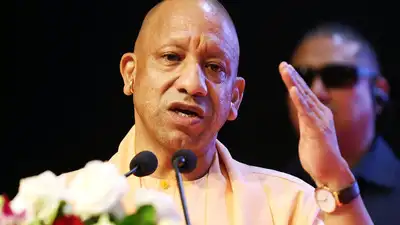
CM Yogi Adityanath
From traditional glassmaking to a modern industrial ecosystem Firozabad, situated near Taj city of Agra, has around 400 registered glass industries, while the Centre for the Development of Glass Industry (CDGI) describes the wider cluster as comprising more than 400 small-scale units and supporting over 1.5 lakh people. The policy approach after 2017 has increasingly sought to address these structural issues. 1,778 beneficiaries received support under the ODOP training programme, while 5,550 beneficiaries were assisted under Vishwakarma Shram Samman Yojana, according to reported district-level data. Firozabad’s glass products are now exported to more than 100 countries, with Europe, the United States, the Middle East, Germany, Russia, Japan and Iran among the reported markets. In June 2026, 81 development projects worth more than Rs 658 crore were inaugurated or launched in the district. Of these, 33 completed projects worth Rs 333.15 crore were inaugurated and 48 projects worth Rs 324.97 crore received foundation stones. The same programme also included keys to 568 beneficiaries under the Pradhan Mantri Awas Yojana (Urban), linking infrastructure development with improvement in household living conditions. Projects approved for the Municipal Corporation include a smart zonal office, digital library, senior citizen care centre and Waste-to-Wonder Park, with projects worth about Rs 54.12 crore included in the 2026 development package. By early 2026, nearly 70 per cent of the project had been completed.
Cleaner, bigger and globally competitive future The Firozabad story is therefore no longer simply about bangles. You Can Also Check: Gold Rate in Lucknow | Silver Rate in Lucknow | Bank Holidays in Lucknow | Public Holidays in Lucknow | Lucknow AQI | Weather in Lucknow | Petrol Price in Lucknow | Diesel Price in Lucknow | CNG Price in Lucknow | LPG Price in Lucknow Stay updated with the latest Lucknow news.
The objective is therefore not merely to preserve the famous Firozabad bangle, but to develop “Made in Firozabad” as a wider global brand. Firozabad is consequently moving towards a model in which the identity of a “Glass City” is complemented by that of a modern industrial and urban centre. Firozabad, popularly known as the Glass City of India and Suhag Nagari, is undergoing a significant transformation. For nearly two centuries, the city’s identity has been inseparable from glass bangles, decorative glassware and traditional craftsmanship. During the last nine years of the Yogi Adityanath government, however, the district’s development narrative has increasingly moved beyond its traditional image. The emphasis has been on modernising the glass industry, strengthening infrastructure, supporting artisans and MSMEs, expanding exports and creating a more organised urban environment. The transformation is perhaps best understood as an attempt to combine heritage with technology and traditional skills with modern enterprise. Its products range from bangles and decorative articles to chandeliers, light shades, laboratory glassware and other specialised products. For years, the sector’s strength lay in its craftsmanship, but it also faced challenges relating to technology, energy efficiency, pollution, design, financing and access to international markets. Modern furnaces and improved production technologies are gradually replacing older, more polluting methods. Japanese pot furnaces and tank-furnace technology have helped improve glass quality and production efficiency, while manufacturers have diversified from traditional bangles into tableware, decorative products, jars and other value-added products. The result is a gradual shift from a predominantly traditional craft cluster to a broader glass manufacturing and design ecosystem. ODOP gives the traditional industry a new economic identity One of the most important interventions has been the One District One Product (ODOP) programme, under which Firozabad’s glass products have been given a central place in the district’s economic strategy. ODOP has attempted to address some of the problems that individual artisans and small manufacturers traditionally faced—limited access to finance, inadequate marketing, lack of modern training and difficulty in scaling up production. Recent figures illustrate the reach of government-supported programmes in the district. The Mukhyamantri Yuva Swarozgar Yojana, Mukhyamantri Yuva Udyami Yojana and PMEGP have also supported hundreds of entrepreneurs. From local craft to global markets The biggest indicator of the changing character of Firozabad is its growing international orientation. The expansion reflects a gradual transition from selling primarily a traditional product to competing internationally in decorative glassware and other specialised categories. The government’s broader industrial policy has also placed emphasis on improving infrastructure, facilitating investment, supporting MSMEs and promoting district-specific industries. The state’s investment policy specifically identifies Firozabad’s glass industry among its specialised district industries. A new focus on organised industrial development Industrial transformation cannot succeed without corresponding improvements in urban and social infrastructure. The Yogi government’s development push in Firozabad has consequently extended beyond industry. The package covered the Tundla and Shikohabad areas and included urban infrastructure and public facilities. For Firozabad, this represents an important change in the development model: industrial growth is increasingly being accompanied by housing, civic infrastructure and public amenities. Smart urban facilities The modernisation agenda is also visible in the plans for Firozabad’s urban spaces. Such projects may appear separate from the glass industry, but they are important to the larger transformation of the city. A globally connected manufacturing centre requires better public spaces, digital facilities, waste management and urban services. Turning heritage into tourism and cultural capital Another striking feature of the transformation is the effort to convert Firozabad’s glass heritage into a tourism and knowledge asset. A Global Glass Museum, being developed at a cost of more than Rs47 crore, is envisaged as India’s first museum dedicated exclusively to glass. The three-storey facility is planned with product and historical galleries, digital storytelling spaces, an AR-VR zone, library, souvenir shop and live glass-blowing demonstrations. This is more than a museum project. It seeks to document the evolution of Firozabad’s glassmaking tradition, showcase its craftsmanship to visitors and provide the city with a cultural landmark capable of supporting tourism. Women and artisans at the centre of the transformation The transformation has also had a social dimension. Glassmaking and associated handicraft activities employ a substantial number of women workers and household-based artisans. Government-supported training, credit and enterprise schemes have sought to provide these workers with better opportunities locally. It is about technology, exports, entrepreneurship, infrastructure, skills and heritage coming together. The challenge ahead will be to ensure that industrial expansion remains environmentally sustainable, that small artisans are not left behind by technological change, and that new industrial zones are supported by reliable roads, utilities and logistics. After nine years of the Yogi government’s tenure, Firozabad’s transformation can thus be seen as a journey from a traditional glass-producing town towards a modern industrial cluster. Its greatest strength remains its centuries-old craftsmanship, but the emerging model is adding technology, finance, organised infrastructure and global market access to that heritage. Download the TOI App.
Recent reporting from the district indicates that artisans who previously travelled to cities such as Delhi and Noida for work are increasingly finding opportunities within Firozabad itself.
In September 2026, the Taj Trapezium Zone authorities approved a proposal to shift glass units located amid residential areas in Firozabad towards UP’s organised industrial areas. An important next stage in the transformation is the attempt to separate industrial activity from densely populated urban areas and create more organised industrial zones. It brings together two objectives: protecting the environment and providing industry with better planned infrastructure. This approach could eventually create a more modern industrial ecosystem with better roads, utilities, waste management and environmental compliance, while reducing the pressure of industrial activity on residential neighbourhoods. Infrastructure The proposed relocation and organisation of glass units, combined with modern production technology, ODOP support, export promotion and new cultural infrastructure, provides a foundation for this next phase.