
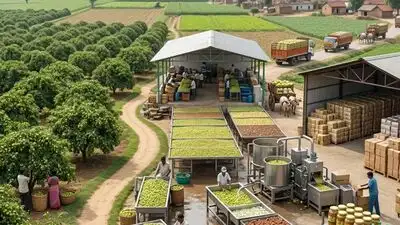
AI Image Used For Representational Purpose Only
It also lists a range of supporting interventions, including the ODOP Common Facility Centre scheme, skill and toolkit support, MSME Policy 2017, food-processing policy, horticulture development programmes, APEDA market and quality-development schemes and National Horticulture Board interventions. The district’s amla-related business turnover was reported to have crossed Rs 50 crore in the previous year, although this figure should be treated as a reported industry estimate rather than an audited government statistic. Because the challenges of a horticultural crop do not end with production, this convergence has been important. Processing therefore becomes critical for converting a seasonal crop into a year-round economic activity. Because they have longer shelf lives and can be branded for consumers, processed amla products can travel much farther than fresh fruit.
Pratapgarh’s association with amla (Indian gooseberry) goes far beyond cultivation. Over the last nine years, the fruit has increasingly evolved from a seasonal farm produce into the foundation of a wider local economy involving farmers, processors, women’s self-help groups, small enterprises, traders, packagers and online sellers. The Uttar Pradesh government’s One District One Product (ODOP) programme has played a central role in this transition by making Amla Products the district’s flagship product and linking cultivation with processing, finance, skill development and markets. Pratapgarh’s amla story is essentially a story of value addition. Instead of limiting the economic opportunity to the sale of fresh fruit during the harvest season, government interventions have encouraged enterprises to convert amla into candy, murabba, pickle, juice, jam, jelly, laddoo, powder, digestive products and other processed foods. This has extended shelf life, opened new markets and created employment beyond the farm. A large number of small and medium enterprises in Pratapgarh are engaged in food processing and that these units generate direct and indirect employment. The most important intervention was the adoption of amla processing as Pratapgarh’s ODOP product. The programme was designed to develop products in which individual districts possess a natural or traditional advantage, while creating an ecosystem for production, processing, branding, finance and marketing. For Pratapgarh, this meant shifting the policy focus from merely growing amla to building an amla-based industry. The ODOP portal identifies Pratapgarh specifically with Amla Products and Food Processing. Farmers need markets; processors need machinery and finance; enterprises need packaging and branding; and finished products need access to consumers. Amla has a relatively short harvesting window. Another important change has been market expansion. Recent reporting indicates that Pratapgarh’s amla products are increasingly reaching larger markets through retail and online platforms, including e-commerce channels. This movement from local commodity to branded consumer product is perhaps the most important structural change in Pratapgarh’s amla economy.
A significant milestone came in March 2023, when Pratapgarh Amla received GI registration. A September 2026 account of Prime Minister Narendra Modi’s Mann Ki Baat highlighted women associated with SHGs in Pratapgarh and their participation in amla processing under ODOP. The group began with two women in 2020 and has subsequently provided employment to 11 women, according to a September 2026 report. The state’s broader MSME Policy 2017 and food-processing interventions have complemented ODOP, creating a policy environment in which small processing enterprises can expand. According to an official report recent around 100 amla-processing units are operational in Pratapgarh, with women linked to self-help groups playing a significant role.
Over the last nine years, the Yogi Adityanath government’s interventions have therefore sought to move Pratapgarh’s amla economy from a predominantly raw-produce model towards a value-added, enterprise-driven and market-linked ecosystem. You Can Also Check: Gold Rate in Lucknow | Silver Rate in Lucknow | Bank Holidays in Lucknow | Public Holidays in Lucknow | Lucknow AQI | Weather in Lucknow | Petrol Price in Lucknow | Diesel Price in Lucknow | CNG Price in Lucknow | LPG Price in Lucknow Stay updated with the latest Lucknow news. A Ministry of Food Processing Industries study on the amla value chain in Pratapgarh identified the need to expand existing processing capacity and strengthen storage. It specifically examined additional lines for products such as candy, murabba, juice and pickle, while also identifying cold storage as an important requirement for extending the shelf life of amla pulp and products. This illustrates the broader policy approach: farm → collection → grading → processing → packaging → branding → market. The government’s support to food-processing enterprises under ODOP has helped create the infrastructure for this chain. The result is that the economic value of one kilogram of amla can extend considerably beyond the price received for the fresh fruit. GI recognition provides a distinctive geographical identity to the product and strengthens the potential for branding and premium positioning. For a district whose economic identity is already strongly associated with amla, the GI tag can help differentiate its produce and processed products in wider markets. This fits into the broader ODOP strategy of taking locally rooted products beyond their traditional markets through better packaging, branding, quality and market access. One of the most visible outcomes of the expanding amla economy has been the participation of women’s self-help groups. Recent government and media accounts highlight women producing amla candy, preserves, juice, pickle and digestive products. Signicance of this development lies in the fact that value addition can be undertaken locally. Instead of the economic benefit ending with the sale of fruit to a trader, women can participate in processing, packaging and marketing. One example is the Savitri Bai Phule Self-Help Group in Devgarh Kamasin village. Another SHG has been involved in producing amla pickle and digestive powder after receiving machinery and access to loans, with opportunities to participate in trade promotion bureau. Thus, the amla economy is increasingly becoming a women-led rural enterprise ecosystem, rather than simply an agricultural activity. The last nine years have also seen greater emphasis on supporting micro-enterprises. Under ODOP, entrepreneurs have benefited from financial assistance, skill development and market-oriented interventions. The programme’s own Pratapgarh page identifies skill and toolkit distribution as well as the Common Facility Centre scheme among relevant interventions. Such measures address a crucial gap in rural economies: possessing a local product does not automatically create a successful business. Entrepreneurs need machinery, working capital, technical knowledge, packaging skills and exposure to consumers. The scale of the ecosystem has also expanded significantly. The figure demonstrates how the ODOP model has moved beyond identifying a product to creating an ecosystem around it. Farmers supply the raw material, processing units add value, workers participate in production and packaging, entrepreneurs market finished products, and traders and digital platforms connect them with consumers. Pratapgarh’s amla experience demonstrates why food processing can be particularly important for agricultural districts. Farming alone is exposed to seasonal prices, perishability and market fluctuations. Processing creates additional economic layers. A farmer can sell fresh amla; a processor can convert it into candy or murabba; a women’s group can make pickles or digestive products; a packaging unit can create consumer-ready products; and a retailer or online seller can take them to markets outside the district. This is precisely the logic behind ODOP: build an industry around what a district already produces well. ODOP has been the central platform, supported by MSME, horticulture, food-processing, skill-development, finance and market-access measures. The transformation is still evolving. Better cold-chain infrastructure, modern packaging, quality certification, wider cultivation, branding and export-oriented market development can further strengthen the value chain. But the direction is clear: Pratapgarh’s amla is no longer merely a fruit grown in orchards; it is increasingly becoming the raw material for a district-wide rural industry. Download the TOI App.