
Lucknow@2040
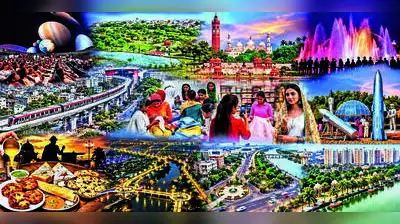
Lucknow@2040 Lucknow@2040 Lucknow@2040 Lucknow@2040 By 2040, Lucknow could be one of the most distinctive metropolitan cities of North India – larger, faster and more connected, but still recognisably Lucknow with its heritage and culture intact. “If the $1 trillion economy target is achieved, some critical changes will happen, particularly in infrastructure.
For example, one challenge for Uttar Pradesh is that its logistics infrastructure is not as developed as it should be,” he said. Lucknow has all the potential to become a city like Hyderabad at some point in time,” he said. Another major area of potential is IT, and yet another is the biotechnology revolution,” he said. He said that be it pharmaceuticals, IT or IT-enabled services, or biotechnology in general, these sectors need to be ignited in Lucknow, along with substantial improvements in infrastructure connectivity and logistics.
The challenge would not simply be to construct more roads, offices and housing, but also to decide what kind of city it should be. Lucknow has always carried contradictions comfortably. It is a city of expanding neighbourhoods and old mohallas, of govt institutions and private enterprises, of modern malls and centuries-old markets. Its reputation rests not only on monuments like Bada Imambara, but also on food, language, hospitality, craftsmanship and an unhurried social culture. “I’m sure that, at some stage, just like Hyderabad, Lucknow will have to be marketed. “If you are looking at transforming Uttar Pradesh, Lucknow must play a major role. One area is logistics. EXPERT VIEW When Lucknow was established as the capital of Awadh, it was essentially an urban centre.
The buildings, Hazratganj, institutional buildings, riverfront, and even residential buildings have historically been integral to the city’s urbanity.
Today’s citizens identify Lucknow through its food (designated as Unesco Creative City of Gastronomy on Oct 31, 2025), colonial and Nawabi history, the unique gharial ecosystem, riverine landscapes, post-independence history, and now its growing commerce and tourism, boom in real estate, technology, and infrastructure projects,” she says. You Can Also Check: Gold Rate in Lucknow | Silver Rate in Lucknow | Bank Holidays in Lucknow | Public Holidays in Lucknow | Lucknow AQI | Weather in Lucknow | Petrol Price in Lucknow | Diesel Price in Lucknow | CNG Price in Lucknow | LPG Price in Lucknow Stay updated with the latest Lucknow news.
The historical is the cultural identity and a fundamental anchor if we are to prepare ourselves to integrate cultural identity into futuristic development,” says Sonal Mithal, a conservation architect who has been working on architectural history and conservation of Lucknow buildings. “The time has come to bring these together, combining nature-cultures with technologies and economies,” says Mithal. “It would be a grave mistake to treat historic buildings merely as heritage and keep them separated from the imagination of the emerging future of the city. “This can only happen if systematic and targeted studies are undertaken with a specific focus on historicity that has the potential to guide and propel the futures. With her students and colleagues, she has worked extensively on the architectural history and putting up forward-looking conservation proposals for Chhatar Manzil, Kaiserbagh, and the Residency, among others. Download the TOI App.
The question for the next 14 years is simple: what should Lucknow become without ceasing to be Lucknow? UPSCR brings together Lucknow, Sitapur, Unnao, Hardoi, Barabanki and Rae Bareli, covering 26,741 sq km. If proper planning is followed over the next 15 years, UPSCR could look very different by 2040. ON THE FAST LANE By 2040, the real measure of success could be how quickly a person or product moves across the region. FLAGBEARER OF USD 1 TRILLION ECONOMY TARGET Arvind Mohan, economist & dean, faculty of arts, Lucknow University , says that if Uttar Pradesh’s economy reaches the $1 trillion economy target or exceeds, Lucknow would majorly contribute to it. “Lucknow has 12 national laboratories.
Anupam Mittal, an architect, says, “Lucknow’s infrastructure is evolving from a centrally concentrated city to a more connected, multi-centred urban region. The need is to propose future urban projects that uphold the town planning initiatives taken in the first half of the 20th century and align with Awadhi culture,” says Mithal, who is a professor and chair of the master’s in Conservation and Regeneration programme at Ahmedabad’s CEPT University. NOT JUST A CAPITAL CITY, BUT A CAPITAL REGION The approval of the base map for the Uttar Pradesh State Capital Region (UPSCR) could mark the beginning of a bigger transformation — one in which Lucknow’s growth is no longer confined to the city but extends across a connected six-district economic region. The next step is approval of the regional plan, which will determine how transport, industry, housing, infrastructure and economic activity are coordinated across the region. Radial roads, ring roads, Kisan Path, proposed Outer Ring Road, Green Corridor, and the State Capital Region are strengthening regional connectivity and enabling more controlled development. Emerging townships such as Varun Vihar are expected to create new commercial and residential centres, reducing pressure on the existing central business district (CBD). Metro expansion and transit-oriented development will further improve connectivity and support higher-density development along transit routes. Together, these initiatives could transform Lucknow into a city with multiple, self-sustaining centres, reducing travel across the city and improving overall urban efficiency. Better highways, public transport, rail links, logistics infrastructure and planned urban corridors could gradually shrink economic distances between Lucknow and its neighbouring districts. A worker living in one district could access a job in another. A farmer could reach a processing centre faster. A manufacturer could move goods to a major market or airport more efficiently. A company setting up outside Lucknow could still access the capital’s talent, institutions and services. “Indeed, many of the expressways pass through Lucknow. All districts of Uttar Pradesh are connected by four-lane roads, and all district headquarters are connected to Lucknow. As logistics infrastructure is developed along these routes, Lucknow will certainly be a major beneficiary,” he added. “Lucknow has to play an important role in several ways. In major states, we have seen transformations. For example, Chandrababu Naidu transformed Andhra Pradesh at one stage. What he did was that, rather than marketing Andhra Pradesh as a whole, Hyderabad was marketed, and Hyderabad transformed itself in many ways. In particular, the IT sector and many other industries relocated to Hyderabad. Lucknow has a similar advantage,” he observed. “If you want to make Lucknow an IT city, one should understand that in the early 1990s, after Bangalore, when people were speculating about which city could become the next major destination for IT or IT-enabled services, Lucknow was considered a frontrunner for a number of reasons. It had all kinds of infrastructure and good schools. Everything needed in terms of manpower was there,” Arvind Mohan pointed out. I don’t think there is any other city that has that many national laboratories, along with so many industries in the surrounding area. There is huge potential for a biotechnology revolution, which is perhaps the next revolution after IT. So, Lucknow could become India’s first biotechnology city,” he added. “This will help project a vision for Lucknow whose future would be unique as it emerges from its culture.