
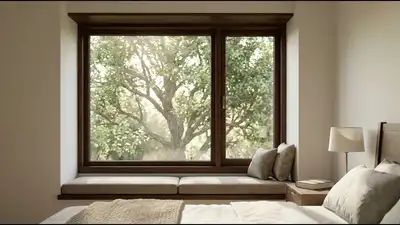
There is no fixed number of windows that suits every bedroom. One well-sized window may work for a smaller room, while larger bedrooms can benefit from two. Size, placement, daylight, ventilation, privacy, heat and the outside view all matter.
Because buildings often sit close to one another, in cities such as Mumbai, window planning becomes more complicated.
“For a smaller bedroom, one well-sized window may be all that is needed,” Vazir said. “In a larger room, two windows can work well, particularly when they are positioned to bring in light from different directions or improve air movement,” he explained. Homes often sit close to neighbouring buildings, so a large opening has to bring in daylight without compromising privacy,” Vazir said. “Where there is a garden, open space or a tree-lined view outside, the window can also give the bedroom a welcome sense of depth,” Vazir explained. “With landscaped spaces and wider setbacks, homes can be planned around views rather than simply around the buildings next door,” he said. “Too many windows can make a room difficult to furnish,” Vazir said. “Depending on the orientation, large glazed surfaces can also bring in considerable heat and glare,” he explained. “The best approach is to consider what the bedroom needs from its windows: morning or evening light, ventilation, privacy, a pleasant view or simply a connection with the outdoors,” Vazir said.
A bedroom with good natural light can feel more settled, open and comfortable through the day. But when it comes to windows, more is not always better. The right number depends on the room, its orientation, ventilation, privacy and what sits outside. Vatsal Vazir, Head of Design at CCI Projects Pvt Ltd, explains why window planning needs more thought than simply counting openings. That single opening can be enough when it brings useful daylight and supports air movement. The size and position of the window matter just as much. A poorly placed large window may not work as well as a smaller one positioned thoughtfully. So, the size of the bedroom can influence the number, but it does not decide it on its own. “In Mumbai, this becomes a more considered exercise. A bedroom window also has to work with its surroundings. A window facing another building may need different treatment from one overlooking a garden or open space. Where the surroundings allow it, a window can do more than provide light. This is where planning at the larger township level can make a difference. A bedroom window facing greenery or an open stretch can make the outdoors feel like part of the room’s setting. A wall filled with windows may look impressive, but it can make everyday bedroom planning harder. There is also the question of heat and glare. “Once those priorities are clear, the number tends to follow naturally. His final point is simple: “A well-designed bedroom does not need to make a statement through its windows. It simply needs to get the relationship between light, air and the outside world right. So, one window can be enough for a smaller bedroom, while two may make sense in a larger room. The better question is not how many windows a bedroom should have, but whether those windows are doing their job well. You use AI every day. Now get your AI Quotient. Take the AIQ test Get the latest Lifestyle News and more. Download the TOI app.
Curtains and blinds can reduce some of these problems, but they should not be the only solution. The most useful approach is to first understand what the bedroom needs from its windows.
Window size and placement need to be considered before the room is finished.