
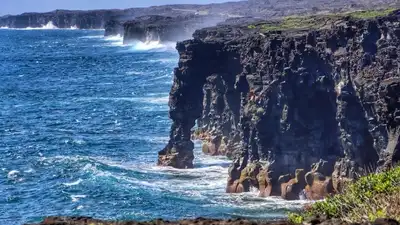
Hawaii’s Hōlei Sea Arch collapses into Pacific Ocean: What caused it and what it says about coastal change
However, sometime between September 23 and 27, 2026, Hawaii just watched that natural icon disappear overnight. What’s the bigger story here, apart from the spectacular disappearance of the roughly 90-foot-high formation? It stood about 90 feet (27.4 metres) high and was formed roughly 550 years ago when ocean waves gradually carved through an ancient lava flow. Earthquakes during the 2018 Kīlauea eruption weakened the cliffs even further, and storms since then, like Tropical Storm Darby in 2020, chewed off sections, pushing the arch closer to collapse. Finally, sometime between September 23 and 27, 2026, it all gave way. Since 1970, Hawaii’s sea level has climbed about five inches, with predictions of another eight inches by 2050, and substantially greater increases by 2100.
Because the park was closed due to yet another storm, Nolo, making it anyone’s guess what actually pushed the structure over the edge, the exact moment went unseen. Because this time, Hawaii is losing more than just one natural landmark. The collapse, confirmed by the US National Park Service (NPS), was dramatic but not entirely surprising: the arch had been weakening for years under the relentless forces of waves, erosion, and geological instability.
Sea arches are temporary features created by erosion, according to the NPS. For more than five centuries, the Hōlei Sea Arch stood on Hawaii’s rugged southern coast like a piece of architecture carved by the Pacific itself. The timing, however, is curious. The collapse happened around the time Tropical Storm Nolo passed Hawaii Island, although the NPS has not established that the storm directly caused the arch to fall. It’s the concern regarding the coastal landscapes that are constantly changing, and Hawaii is increasingly vulnerable to erosion, rising seas, and stronger coastal impacts linked to a warming climate. For the unversed, the Hōlei Sea Arch was a natural lava-rock formation at the end of Chain of Craters Road in Hawaiʻi Volcanoes National Park on the Big Island. Why hōlei? Well, the name comes from hōlei, a small endemic plant in the milkweed family. For visitors from all over the world, this arch was one of the most fascinating attractions along the park’s dramatic southern coastline. However, it’s important to note that, geologically, it was never meant to stand there permanently. Waves first carve caves into coastal cliffs; continued pounding enlarges those openings until a bridge of rock remains. Eventually, that bridge becomes too weak to support itself and collapses, leaving behind a sea stack or fragments of rock. The immediate cause was erosion and structural weakening, rather than a single sudden event. However, the arch’s story has always been one of slow, steady destruction. For centuries, pounding surf, wind, and earthquakes chipped away at its base. In the last decade, things sped up. Turns out, it’s not so simple. Sure, sea arches are destined to crumble eventually. After all, it’s how the ocean works. Constant waves and weather carve openings in the lava till the rock just can’t hold up. But there’s a bigger picture. Rising seas, heavier surf, and stronger storms (all linked to a warming climate) are picking up the pace of coastal erosion across the islands. Now that’s not a trivial amount for beaches, homes, and roads perched right at the shore.
However, the emotional punch of seeing a 550-year-old formation disappear hits home for island residents and visitors. With the arch gone, safety is the top concern. Cliffs in that area are even more unstable, so the National Park Service is urging people to stay clear. One slip can be fatal, and falling rocks or rogue waves aren’t forgiving. But from a geological standpoint, this is just business as usual. Coasts change, arches collapse, and new formations will eventually show up somewhere else along the shore. If anything, it’s a wake-up call: change is coming faster. Erosion isn’t just about losing photo ops. Beaches can vanish, neighborhoods can end up underwater, and essential infrastructure could be threatened — all while native ecosystems scramble to keep up. You use AI every day. Now get your AI Quotient. Take the AIQ test Get the latest Lifestyle News and more. Download the TOI app.