
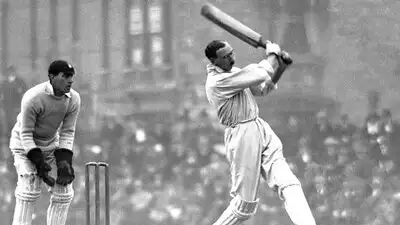
Percy Fender (Pic credit: PA Images/Alamy)
Fender went on to score 113 in 42 minutes
Percy Fender smashed his hundred in just 35 minutes for Surrey against Northamptonshire at Northampton on August 26, 1920 — and despite several later centuries being completed in less time, none have been accepted as a genuine challenge to his mark. He finished unbeaten on 113 from 42 minutes, hitting 16 fours and five sixes. Remarkably, 94 of his 113 runs came in boundaries, meaning more than 83 per cent of his score came from fours and sixes. Peach finished unbeaten on 203, while the sixth-wicket pair had added 171 runs in only 42 minutes. For 63 years, Fender stood alone. Glen Chapple hit a century in 21 minutes for Lancashire against Glamorgan in 1993. Mark Pettini scored one in 24 minutes for Essex against Leicestershire in 2006, while Michael Goodwin and Tom Moody also produced centuries in 25 and 26 minutes respectively.
Because cricket’s record books make an important distinction between a breathtaking batting assault and a century produced in deliberately staged circumstances, fender’s record has survived.
That distinction is crucial when discussing the “fastest century” in cricket. The fastest century in first-class cricket by time spent at the crease was scored more than a century ago, yet the record remains intact. Fender did not slow down after reaching the landmark. Surrey declared once Peach reached his double-century. The speed of Fender’s innings was extraordinary even by modern T20 standards. Yet the record is not simply about how many balls Fender faced. It is specifically a record for the time elapsed while the batter was at the crease, an older method of measuring batting speed that differs from modern balls-faced records. Then came Steve O’Shaughnessy. O’Shaughnessy was not the only batter to score faster than Fender.
Steve O’Shaughnessy equalled Fender’s 35-minute mark for Lancashire against Leicestershire in 1983, while centuries have since been timed at even quicker rates. Northamptonshire made 306 in their first innings, with Fanny Walden scoring 128. Surrey initially found themselves in trouble at 160 for four after Andy Sandham fell for 92. But Andy Ducat and Alan Peach transformed the innings, adding 288 in just 135 minutes. Ducat eventually fell for 149, leaving Fender to take centre stage. He raced to his fifty in just 19 minutes, with Northamptonshire struggling to find a way of slowing him down. Gilbert Jessop had previously held the record for the fastest first-class century, reaching three figures in 40 minutes against Yorkshire at Harrogate in 1897. He eventually reached his century in 35 minutes. The Lancashire all-rounder scored a century in 35 minutes against Leicestershire in 1983, apparently matching Fender’s record. Fowler smashed 100, including 10 sixes, while O’Shaughnessy also raced to three figures. He reached his century in 35 minutes — but the innings was effectively produced under manufactured conditions designed to accelerate scoring. More than 100 years after he unleashed his extraordinary attack on Northamptonshire, no legitimate first-class innings has bettered his 35-minute mark. And that is why, despite several faster-looking centuries appearing in the record books, Percy Fender’s 35-minute hundred from 1920 remains the gold standard for the fastest authentic first-class century by time.
As a result, Fender’s 35-minute hundred remains widely regarded as the fastest authentic first-class century in terms of time taken. But those performances came in matches where the bowling and circumstances were manipulated to force a result or achieve specific objectives. Four days after his 28th birthday, Fender walked out for Surrey in a County Championship match that would become one of the most remarkable batting spectacles of his career. Fender contributed with the ball, taking three wickets. What followed was extraordinary. Fender attacked almost from the moment he arrived, unleashing booming drives, fierce cuts, pulls and trademark slashes. Fender went five minutes faster. But the circumstances surrounding the innings made it impossible to treat it as an equivalent achievement. The match had been disrupted by bad weather, with play beginning late. By the final day, both teams had specific incentives to accelerate proceedings. After Leicestershire declared, O’Shaughnessy and Graeme Fowler walked out for Lancashire against an attack that included David Gower and James Whitaker. What followed was described as farcical. Gower and Whitaker bowled a succession of full tosses and long hops, while the short boundary made attacking cricket even easier. But these innings belong to the category of centuries that do not count for the genuine time-based record. Manufactured declarations and deliberately friendly bowling were once a feature of County Championship cricket, particularly when matches were played over three days. Captains sometimes had to find extraordinary ways of creating enough time for a result after weather interruptions or slow play. Part-time bowlers delivering full tosses and long hops could turn an innings into a boundary-hitting exercise. records created under such conditions have generally been regarded as staged and unsuitable for comparison Although the runs officially counted in the match scorecard. Get the latest Sports News and Live updates. Download the TOI app.
That leaves Fender’s 1920 performance as the benchmark. In Test cricket, Brendon McCullum holds the record, scoring his century from 54 balls against Australia in Christchurch in 2016.
Join conversation Share your thoughts in the comments Be respectful · TOI community guidelines If “fastest century” is measured by balls faced, rather than time spent at the crease, the first-class record belongs to David Hookes, who scored 102 from just 34 balls for South Australia against Victoria in 1982. There is another important distinction. But by elapsed time in genuine first-class conditions, Fender remains the man to beat.