
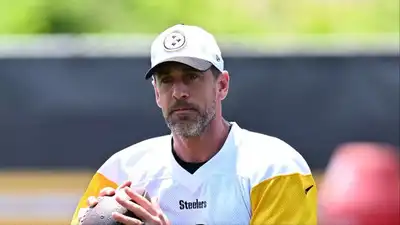
How Aaron Rodgers can follow Tom Brady and Peyton Manning’s late-career blueprint to remain an elite NFL quarterback (Getty Images)
Aaron Rodgers is 42, coming off a modest first season in Pittsburgh, and has publicly declared 2026-27 his final NFL ride. The Steelers went 3,322 passing yards and an AFC North title last year, but that ugly 30-6 playoff loss to Houston told a sharper story. Rodgers completed barely half his passes, finished with a 50.8 passer rating, and looked every bit his age under pressure. Manning’s last year with the Broncos in 2015 is the most instructive parallel here. His yards per attempt fell to 6.8, down from 8.3 during his 2013 MVP peak. Manning eventually got his job back for the playoffs and won the Super Bowl, but he did it by throwing 179 passing yards per game in three postseason games and just two touchdown passes. Brady’s 2022 swan song is probably the most uncomfortable cautionary tale for Rodgers. The Buccaneers lost Rob Gronkowski to retirement, their offensive line collapsed through injuries, and Tampa Bay limped to an 8-9 record before getting blown out by Dallas 31-14 in the Wild Card round.
I’m not saying he lost any velocity on the ball, but if he has, it’s definitely made up for with his anticipation.
“His mind’s incredibly sharp,” McCarthy told FOX Sports’ Ralph Vacchiano. Now, with Mike McCarthy back on the sideline and a full training camp under his belt, the question is not whether Rodgers can survive the season. It is whether he can actually matter in it. McCarthy, who coached Rodgers through his best years in Green Bay, has been openly enthusiastic about what he has seen this summer. “But I’ll be honest with you, his ball play in this camp has been top-notch. Obviously, I’ve coached a lot of football with him, but his ability to place the football… So he’s getting the ball where it needs to be, on time. He’s having a hell of a camp. His arm was shot. Denver’s coaching staff even benched him briefly in favor of Brock Osweiler. Brady was clearly diminished, operating behind a patchwork line and without the safety net of his most reliable target. Rodgers faces a similar offensive line concern. ESPN ranked Pittsburgh’s line 30th in the league heading into this season. Pro Football Network had them third. That gap in assessment tells you everything about the uncertainty. If those blockers cannot hold up, Rodgers will be taking hits and making decisions under pressure he cannot afford at this stage of his career.
Rodgers said as much when explaining why he came back: “When the decision was made to hire Mike, I started opening my mind back up to coming back. Training camp praise is easy to find in August. Every team sounds good in July. But the McCarthy-Rodgers reunion is not nothing. Familiarity with a quarterback’s rhythms and tendencies matters more when that quarterback is running on instinct and experience rather than raw arm talent. ” The lesson for Rodgers is clear. Pittsburgh already has one of the NFL’s most feared pass-rushing units. The skill position group around him has enough potential. Rodgers does not need to carry this team. He needs to manage the game, make sharp decisions, and stay out of his own way. That is a harder adjustment mentally than physically for a four-time MVP who has spent two decades trusting his arm to bail him out.