
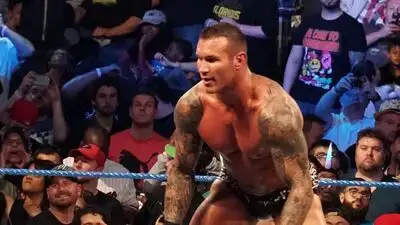
Orton in 2018. Image Credit: Wikipedia
One of the most notable is the Bible verse 1 Peter 5:8. Other tattoos reflect his relationship with his wife, Kimberly Kessler, whom he married in 2015. Orton’s tattoos attracted legal attention through a dispute involving tattoo artist Catherine Alexander, who created several of the designs on his body between 2003 and 2008.
Orton’s tattoos have therefore become part of his wider presentation as a WWE veteran. It also revealed that copyright questions can arise when artwork permanently attached to a person’s body is reproduced commercially.
The name “Kim” and a heart on his left ring finger serve as a personal tribute to their marriage. Randy Orton has spent more than two decades establishing himself as one of WWE ’s most recognisable performers. Known as The Viper, the veteran wrestler is associated with his calculated in-ring style, signature RKO and distinctive appearance, and his tattoos have become an important part of that image, evolving alongside his character and career. However, Orton’s body art tells a story beyond professional wrestling, and his designs include references to his family, religious beliefs and personal experiences, while the development of his tattoo collection reflects changes in his public persona. The artwork has also attracted attention outside the ring, particularly through a copyright dispute involving the reproduction of his tattoos in WWE video games. Orton’s tattoos developed over several stages of his wrestling career, beginning with tribal-inspired designs and expanding into larger pieces across his arms and back, and the artwork helped establish a distinctive visual identity that audiences could recognise immediately, whether he was competing in the ring, appearing on television or promoting WWE events. Some of his earliest designs reflected the tattoo styles popular during his early wrestling years. The tribal artwork across his upper back became one of the defining elements of his appearance, while additional designs gradually covered his arms. Over time, these pieces developed into a more extensive collection featuring skulls, religious imagery and personal symbols. Orton’s time in the United States Marine Corps also forms part of the background to his tattoo history. His military service ended with a bad-conduct discharge after he went absent without leave, a chapter that preceded his eventual rise in professional wrestling. As Orton’s WWE career continued, his look became more and more synonymous with his nickname, The Viper, and the character’s tattoos contributed to an intimidating presentation, making for a cohesive look that separated him from other wrestlers. his body art also contains personal references that extend beyond the character Although wrestling personas are carefully developed for television. Several of Orton’s tattoos have meanings connected to his family and beliefs. This references vigilance and the presence of an adversary. Located on his arm it makes it a visible part of his tattoo collection and adds a religious component to the designs associated with his wrestling persona. His family tributes offer a more intimate side of the artwork. Orton has his daughter Alanna’s name and birthdate represented on his arm, with Roman numerals used for the date. A red and green rose tattoo on his left bicep has also been described as a tribute to his daughter, bringing floral imagery into a collection otherwise known for darker and more aggressive designs. Orton also has small lettering on his left rib cage that matches a tattoo on Kessler’s collarbone, providing another connection between their body art. These designs contrast with the skulls and tribal patterns associated with The Viper, while the larger pieces contribute to his on-screen image, the family-related tattoos carry meanings tied to relationships outside WWE. Together, they show how his collection combines professional identity with personal milestones rather than serving only as a visual statement. Orton’s transformation into The Viper involved more than his wrestling style and signature moves, and his increasingly extensive tattoos became a defining part of his appearance, reinforcing the character’s dangerous, unpredictable presentation. The interlocking tribal patterns and skull imagery across his arms helped create a recognisable silhouette that remained consistent throughout different stages of his WWE career. His upper-back tribal tattoo dates to his developmental wrestling period in Ohio Valley Wrestling. Reports about the design describe complications with its healing during training, which reportedly required further work. As Orton gained experience and became a main-event performer, additional tattoos expanded the visual identity established by that early piece. The religious and floral elements add contrast, preventing the collection from being defined solely by aggressive imagery. They distinguish him in promotional photography, television appearances and video-game character models, where wrestlers’ visual details are recreated for audiences. Their visibility has also made the artwork relevant to conversations about how athletes and entertainers are represented in commercial media. Alexander argued that reproducing the tattoos on Orton’s likeness in WWE video games infringed her copyrights. The case involved WWE, Take-Two Interactive and other companies connected to the games. The dispute raised a question that extends beyond wrestling: who controls the reproduction rights to artwork inked on another person’s body? Alexander argued that she retained copyright in the original designs Although Orton wears the tattoos. The issue became particularly relevant as video games increasingly sought to reproduce athletes and entertainers with realistic detail. Join conversation Share your thoughts in the comments Be respectful · TOI community guidelines The case did not mean that any tattoo appearing in a video game was automatically an infringement. The legal outcome was determined by the particular facts of the dispute and the rights at stake. But it did bring more attention to the need for entertainment companies to think about tattoo designs when building realistic character models, promo material and other commercial representations. The lawsuit added an unexpected twist to the tale of Orton’s body art. His tattoos had been a long-standing part of his personal identity and wrestling persona, but the dispute showed they could also become a matter of intellectual property law. The case clarified the difference between a performer’s likeness and the separately created artwork that appears on that likeness. Get the latest Sports News and Live updates. Download the TOI app.
He previously had a USMC tattoo on his arm, but the design was later covered.