
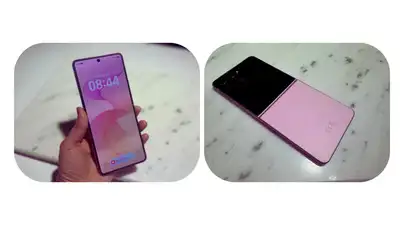
Samsung Galaxy Z Flip 8 first impressions: A bigger FlexWindow, Dual Recording and Exynos 2600 in the slimmest Flip yet
At 3.9 inches it is generously sized by flip phone standards, and the expanded Now Brief feature takes full advantage of that real estate in a way that feels like a genuine evolution of how the cover screen is used day to day. The Z Flip 8 ships with Android 17 and One UI 9, and Samsung’s software investment in the Flip experience shows most clearly in how the FlexWindow and Galaxy AI features have been integrated. Galaxy AI’s agentic capabilities, which allow the AI to take multi-step actions across apps on behalf of the user, are present on the Z Flip 8 as they are across the full Z8 lineup. The camera system is where the Z Flip 8 shows its most meaningful generational improvement.
The FlexWindow on the cover is the design element that has received the most meaningful attention this generation. The Now Brief feature on the FlexWindow provides quick updates and AI-summarised information on the cover screen, reducing how often you need to open the phone for routine checks. For a device whose central appeal is the satisfaction and compactness of the folded form, reducing the friction of staying informed without unfolding is precisely the right software focus. The deeper Gemini integration through Samsung’s partnership with Google means AI assistance is available with genuine context awareness across native Samsung apps. For a Flip user, this surfaces most usefully in the camera app and in communication features, where AI can assist with message drafting, photo editing suggestions and real-time translation without requiring navigation away from the task at hand. On a clamshell device, the most natural use cases are quick tasks initiated from the cover screen that the AI can complete without requiring the phone to be opened. New features include Camcorder Grip, Super Steady with Horizontal Lock, and Dual Recording, which captures both the creator and the subject simultaneously. Super Steady with Horizontal Lock addresses one of the more persistent frustrations of shooting handheld video on a flip phone — the tendency for footage to feel unstable when the phone is held in unconventional grips. The Horizontal Lock element keeps the video output oriented correctly even when the device is tilted, which is particularly useful for Camcorder Grip mode, where the phone is held at angles a conventional stabilisation system would struggle with. The camera hardware itself carries a dual 50MP rear system, and in the daylight shooting available at the launch event, the primary sensor produced clean, well-exposed images with accurate colours consistent with what we have come to expect from Samsung’s current camera processing.
What we think
The Galaxy Z Flip 8, successor to the Galaxy Z Flip 7, was launched at the company’s Galaxy Unpacked event in London alongside two other foldables — the Galaxy Z Fold 8 Ultra and the Galaxy Z Fold 8. The phone is powered by Samsung’s own Exynos 2600 chipset and runs Android 17. The Galaxy Z Flip 8 comes in at 6.1mm thick when unfolded and weighs 180 grams, which makes it one of the slimmest and lightest flip foldables currently available. The Exynos 2600 chipset means regional variants may differ in processor configuration depending on the market, which is worth checking at the point of purchase. The Galaxy Z Flip 8 features a 6.9-inch inner display, a slight increase over its predecessor, and the panel quality is consistent with Samsung’s flagship AMOLED standards. The camera use case for Flex Mode is particularly well implemented on the Z Flip 8, as we will come to. The Galaxy Z Flip 8 is powered by the Exynos 2600 chipset with 12GB of RAM and storage options of 256GB and 512GB. The Exynos 2600 is Samsung’s own silicon and represents the company’s latest in-house processor generation, and for a device oriented toward lifestyle and camera use rather than sustained heavy workloads, it performs comfortably. The battery is a 4,300mAh cell, an improvement over previous generations, and it should deliver reliable all-day endurance under typical flip phone usage patterns. Seven major Android OS upgrades are promised on the Z Flip 8, matching the software commitment across the full Z8 lineup and representing Samsung’s industry-leading approach to long-term software support. Dual Recording is the headline camera addition for the Z Flip 8’s target audience. The Samsung Galaxy Z Flip 8 is a confident, well-refined iteration of the clamshell flip formula, and it makes its best case in the two areas where its audience cares most: the FlexWindow experience and the camera system. It is not the most dramatically changed device in Samsung’s 2026 lineup — that distinction belongs comfortably to the Z Fold 8 and its entirely new form factor. But the Z Flip 8 does not need to be dramatic.
Samsung has a new flip phone, and this time the cover screen does most of the talking. Samsung is pitching it at users who want their phone to feel as dynamic as they are, built around quick interactions, personal expression and AI-native experiences, with Galaxy AI pushed closer to everyday moments through a reimagined FlexWindow. We spent some time with, and here are our first impressions. In the hand it feels genuinely refined, with a build quality that has benefited from Samsung’s years of hinge and chassis engineering across the Flip lineup. The hinge opens and closes with a satisfying resistance, and the overall feel when folded is of a compact, well-constructed object rather than a phone that has been persuaded into an unusual shape. Colour options continue Samsung’s practice of offering both understated and expressive choices for what is inherently the more fashion-forward of its two foldable lines. Colours are vivid and accurate, blacks are deep, and the overall viewing experience when the phone is unfolded is as good as any conventional flagship Samsung has made. The cover FlexWindow is where the display story gets more interesting this generation. It now features Now Brief for quick updates, surfacing contextually relevant information including weather, schedule, notifications and AI-assisted summaries without requiring the phone to be opened. In hands-on time at the event, the Now Brief implementation felt more genuinely useful than the cover screen experience on previous Flip generations, which often felt supplementary rather than primary. The inner screen also supports Flex Mode, which splits the screen at the hinge point when the phone is partially folded, allowing one half to display content and the other to function as a viewfinder or control interface. In brief hands-on testing, the interface was fast and responsive, with no hesitation during navigation, multitasking or camera switching. The compact form factor means the battery cannot match the capacity of bar-style phones at similar prices, which has always been the honest trade-off of the clamshell design. Using both the rear cameras and the under-display inner camera at once, it captures what the subject is doing and the creator’s reaction at the same time, which for content creators and social media users is a genuinely useful capability rather than a gimmick. In brief testing at the launch event, the dual recording output was smooth and the synchronisation between the two feeds was clean. It needs to be the best version of a form factor its buyers have already chosen, and on first impression, it largely delivers that. Get the latest technology news and updates. Download the TOI App.