
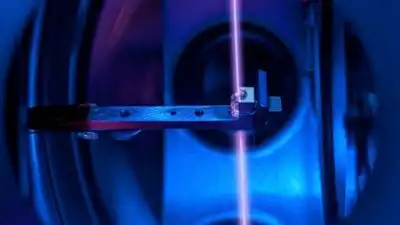
Developed at TU Wien (Vienna) and detailed in the journal Nature, the experimental system operated stably for more than 24 hours without external intervention. For generations, the world’s most demanding measurements have relied on atomic clocks. Now, researchers in Austria have built the world’s first self-stabilising nuclear clock, opening the door to an era of measurement that could eventually eclipse conventional atomic standards. The milestone marks a major leap toward high-performance metrology, promising high precision in tracking physical quantities across science and engineering.
The project reached its foundational breakthroughs in 2024. In April 2024, a collaboration led by Professor Thorsten Schumm at TU Wien’s Institute of Atomic and Subatomic Physics and Professor Ekkehard Peik at PTB Braunschweig demonstrated for the first time that thorium nuclei could be excited using laser beams. Then in Autumn 2024, the joint team built an initial timekeeping device by linking the thorium excitation setup to a traditional optical atomic clock, using the nuclei as a reference guide. Atomic nuclei are more than 10,000 times smaller than whole atoms, and so they are less easily disturbed by external electromagnetic forces.This makes them significantly more durable and steady as long-term timekeepers. During a 24-hour testing window, the prototype demonstrated an accuracy level of approximately 10 to the power of minus 15, which works out to an error of roughly one second every 30 million years.
Because environmental factors, including temperature swings, can cause the laser frequencies to drift, the internal anchor is needed.
Since the energetic gap is narrow, scientists can use a standard laser to “switch” the nucleus from one level to another. Standard atomic clocks track the transition of electrons between energy states outside the atomic nucleus. For decades, however, physicists suspected that thorium atomic nuclei held a unique physical quirk. Unlike other elements, thorium features two distinct nuclear energy states that sit remarkably close to each other. In almost all other elements, the nuclear energy threshold is far too massive to respond to laser light. The ultimate prize remained an autonomous, self-correcting apparatus. “What you really want is a self-stabilizing nuclear clock. The basic idea is simple: you have a laser and you have thorium. The laser changes the energy state of the thorium nuclei, and the thorium nuclei are used to stabilize the frequency of the laser,” explained Professor Thorsten Schumm. At the core of the system is a specialised crystal embedded with thorium atoms, fabricated at TU Wien. A laser continuously irradiates the crystal, using the light’s oscillation as the ticking rhythm of the clock. In this arrangement, the thorium nuclei provide that anchoring. When the beam is at the exact resonance frequency, the nuclei absorb the laser light: Frequency: Absorption is at its maximum. Frequency Drift: Absorption falls off noticeably even with a slight shaking of the beam. Automatic Correction The drop creates an automatic correction, pulling the laser back to the exact frequency, preserving the steady tick rhythm, without the need for an external atomic clock. it represents a remarkable baseline for a first-generation prototype While Schumm notes that the initial performance does not yet match the absolute records set by the world’s most advanced optical atomic clocks. You use AI every day. Now get your AI Quotient. Take the AIQ test.
it still relied on an optical atomic clock as a crutch While that earlier prototype proved the concept.