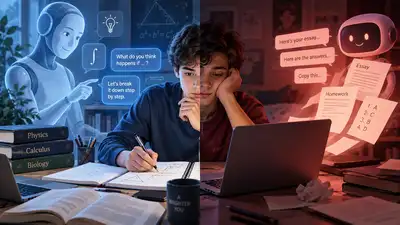
AI generated image
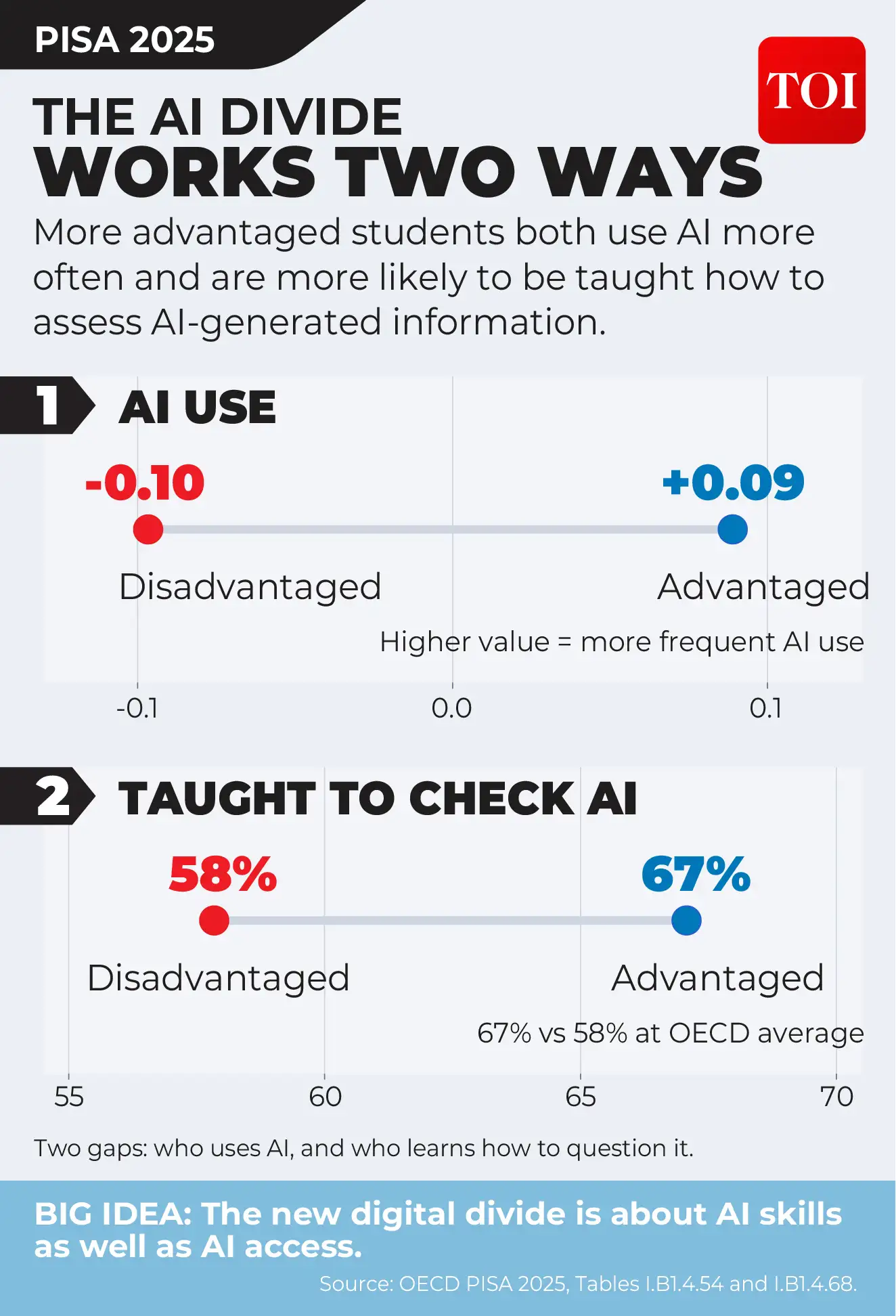
A randomised experiment involving nearly 1,000 high-school maths students tested two systems. performance rose sharply and students using GPT Base did 48% better on practice problems than the control group, and those using GPT Tutor 127% better While AI was available. Its 2015 report found that students who used computers very frequently performed worse, and that heavy national investment in classroom technology had produced no corresponding gains. By 2022 the concern had moved from access to attention, with about 30% of students reporting that they were distracted while using digital devices in most or every mathematics lesson. They are also more likely to be taught how to assess the information AI produces: 67% said they had been given school tasks requiring them to assess AI-generated information, against about 58% of disadvantaged students, a gap of more than nine percentage points.
GPT Base behaved broadly like an ordinary chatbot. GPT Tutor was designed to guide students through problems rather than hand over answers. PISA has been circling the same anxiety for a decade. The broader decline had already begun before generative AI became widely available. What AI adds is an easier way to avoid practising the skills that are already weakening. Across the OECD, students from more advantaged backgrounds use AI more frequently than disadvantaged students. The AI Divide
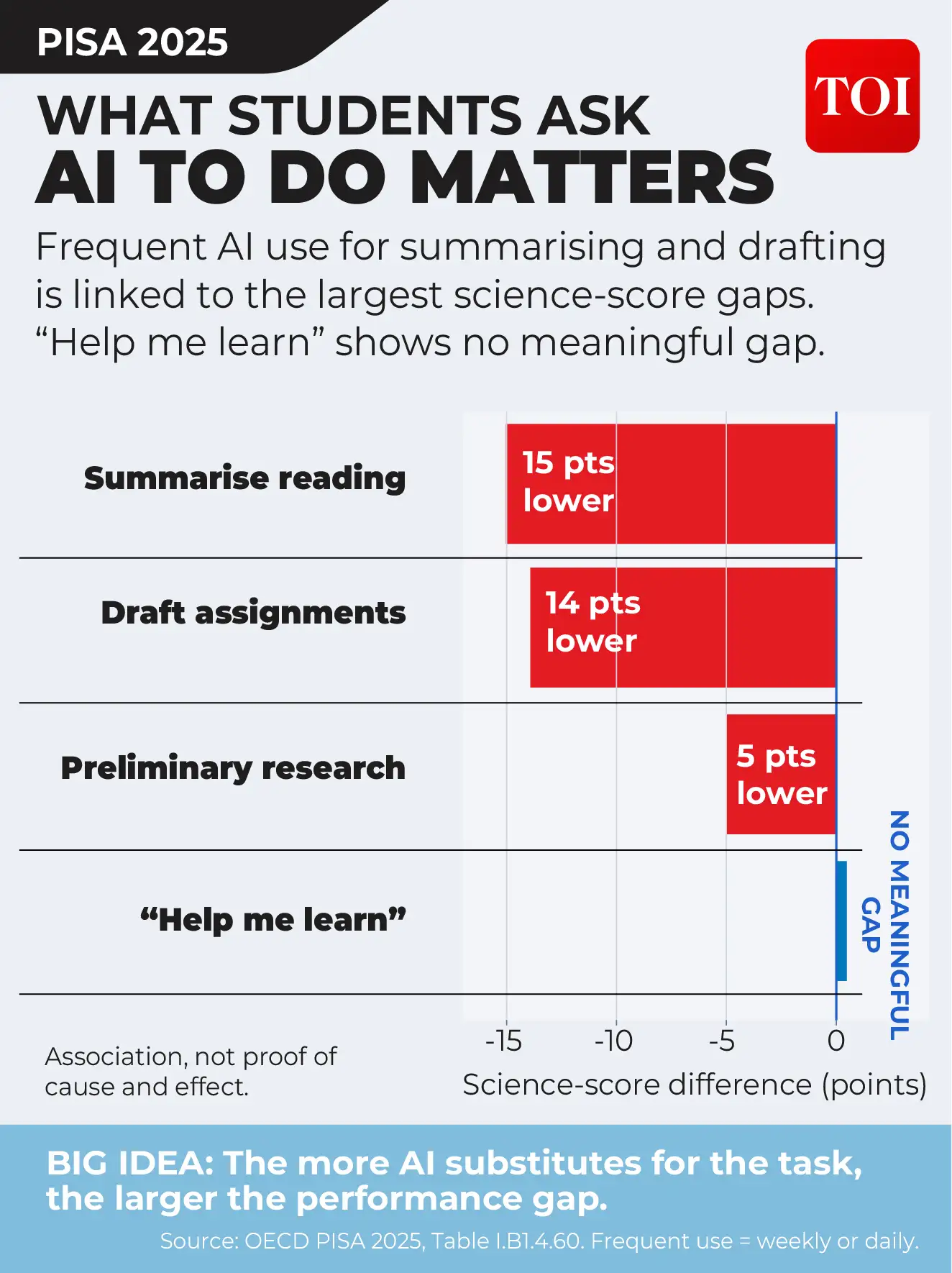
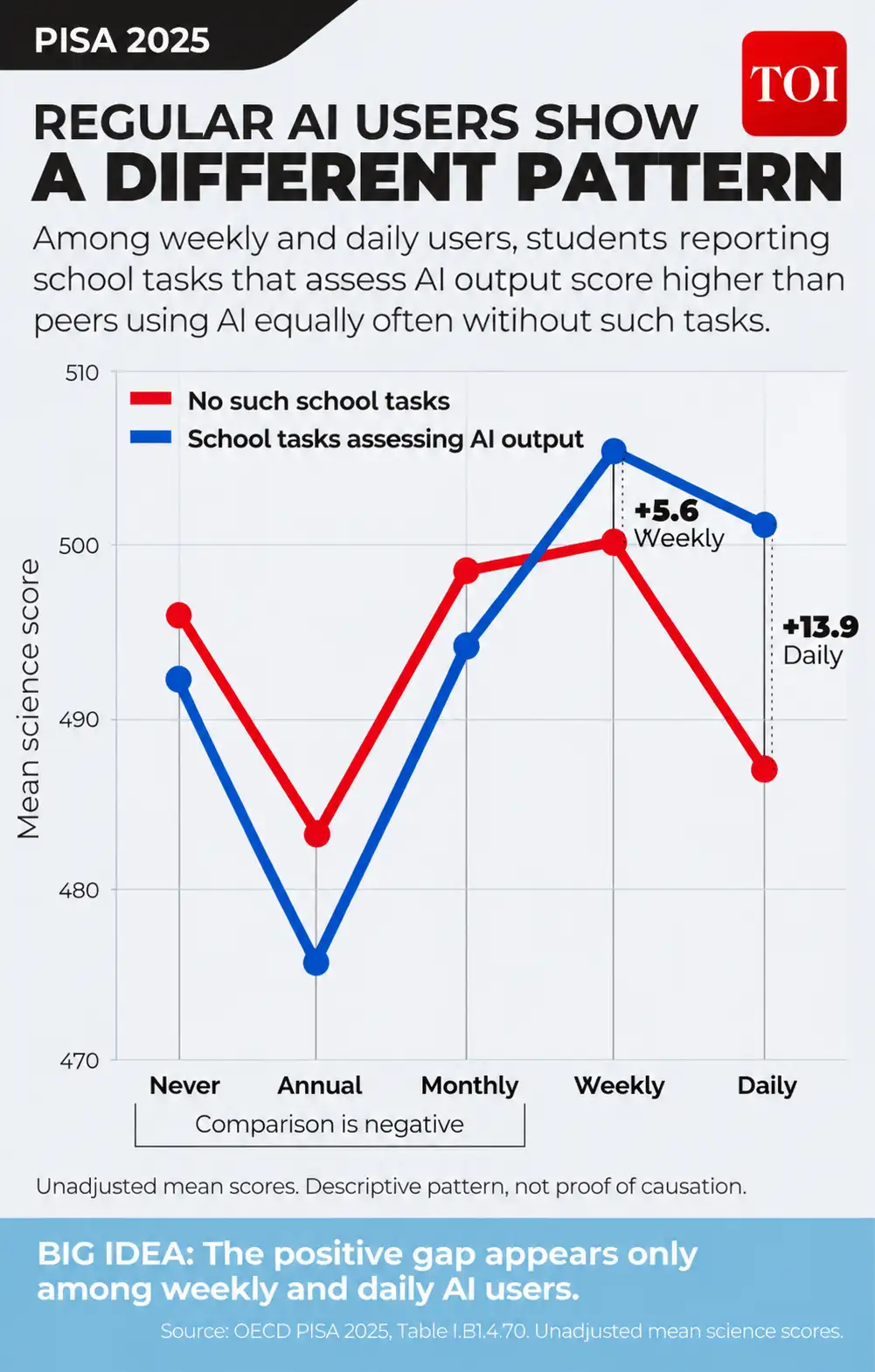
A recent study following 26,811 secondary-school students in central China found that after students adopted generative AI, their homework scores rose 18% while the time spent completing homework fell 30%. Within six months, researchers estimated exam scores were 20% lower, and on two high-stakes entrance examinations the estimated declines eventually reached 24% and 18%. PISA 2025 shows a similar split at a much larger scale, and it moves the question away from whether students use AI to what they do with it. PISA is the Programme for International Student Assessment, run by the Organisation for Economic Co-operation and Development (OECD), the Paris-based group of 38 member countries. Held every three years since 2000, the test is taken by 15-year-olds, roughly secondary-school age in India. Each cycle takes one subject as its main domain, and in 2025 that was science, with reading, mathematics and computational problem-solving alongside. India has participated once, in PISA 2009+, through schools in Tamil Nadu and Himachal Pradesh. A 2025 nationwide survey of more than 5,000 teachers by the Centre for Teacher Accreditation found over 70% already using AI in their teaching, with lesson planning the most common use. More than 760,000 15-year-olds across 91 countries and economies took part in PISA 2025. Roughly three in ten used AI that often for specific tasks: 31.2% for preliminary research, 29.7% to summarise assigned reading and 28.8% to draft written assignments. Even after allowing for differences in students’ and schools’ socio-economic backgrounds, frequent AI use to summarise assigned reading was associated with science scores about 15 points lower, and using it to draft assignments with scores about 14 points lower, according to PISA. The gap for preliminary research was smaller, at about 5 points. Students who had used ordinary GPT Base performed 17% worse on the subsequent unaided exam than students who had never had AI. About 72% of daily users said they liked learning new things, compared with about 66% of non-users, and daily users also reported seeking help more actively. The share of students OECD classifies as hasty readers, those who respond quickly and inaccurately, rose from 6.6% in 2018 to 11.4% in 2025. Between 2015 and 2025, average OECD reading performance fell 28 points and mathematics fell 22 points, and the share of students below the basic benchmark in reading, mathematics and science rose from 16% in 2022 to 20% in 2025. Among students using AI equally often, though, those who also reported school exercises in checking AI-generated information scored about 6 points higher among weekly users and 14 points higher among daily users. What PISA 2025 leaves open is how much thinking they can hand to a machine before the habit of thinking for themselves begins to weaken.
The distinction that matters may therefore be between AI used as learning support and AI used as a task substitute, rather than between AI users and non-users. PISA 2025 suggests the harder challenge lies in redesigning assignments so that they still demand real thinking.
Across OECD countries, 45.5% said they used AI chatbots at least weekly to “help me learn”. When students used AI more broadly to “help me learn”, the estimated gap was half a point, too small to be statistically significant. Daily users of AI “to help me learn” reported greater curiosity than students who never used it for that purpose. Students who said they had been taught to assess AI-generated information did not consistently score higher in science once socio-economic differences were taken into account.
Confessions of complete dependence on AI chatbots, of not being able to think of writing without ChatGPT, are increasingly heard in classrooms and offices. with Anthropic’s chief executive calling this month for the industry to slow the pace of AI capability gains, the effect of AI on Gen Z and Alpha is something everyone is curious about While the debate around generative AI gains steam. Will a generation swept by the wave of artificial intelligence still look to develop its own thinking in the formative years of life? Then came the closed-book examinations. The losses were concentrated among students whose unusually high homework scores and unusually fast completion times suggested substantial outsourcing to AI. Students who kept spending as much time on homework as non-users experienced much smaller losses. It is not a syllabus examination. Students are given unfamiliar real-world material and asked to reason with it. Around the test sit background questionnaires covering home circumstances, attitudes to school, curiosity and, for the first time at this scale, how students use AI chatbots for schoolwork. However, Indian classrooms are also using AI. These are OECD’s own published estimates, not our calculation. How AI is impacting students It may be the case that students already struggling are more likely to ask AI to summarise or draft work, and other differences can remain even after socio-economic background is taken into account. OECD itself cautions against causal interpretation. Sans AI, the result was instructive. For the group that had used the guardrailed GPT Tutor, that negative effect essentially disappeared. Unrestricted GPT users often asked for or copied solutions, while users of the guided version were more likely to attempt problems or seek guidance. The same underlying technology produced very different outcomes, depending on whether it supported the student’s thinking or replaced it. PISA also weakens the easy explanation that frequent AI users are simply less interested in learning. The pattern is not a straight line, dipping among occasional users before rising among regular ones. We are in the age of instant dopamine hits. Each scroll needs to give some sort of validation, or else a reel gets swiped off in a flash. Teenagers are not immune to this trend, and concerns about what it means for sustained attention are growing. PISA’s own reading data shows the strain. Schools might conclude that the answer is simply more AI-literacy lessons. PISA suggests it is not that straightforward. Among students who used AI less often, the comparison was negative. Critical thinking is key These are unadjusted mean scores and not causal evidence. They do, however, raise the possibility that learning how to question AI becomes more relevant once AI is already part of a student’s routine. For generations, homework meant something. It helped students reflect on what they had been taught and reproduce it. It was essentially a precursor of examination. A person doing homework in a dedicated manner was expected to have got the grasp of the subject. With generative AI, that assumption has bitten the dust. The work bit of homework is often transferred to ChatGPT. For the first few years of generative AI, schools focused on detection. Teenagers are already using AI. Machine learning without humans learning would be one of the great ironies of the AI age. Get the latest technology news and updates. Download the TOI App.
India hasn’t taken part since then.