
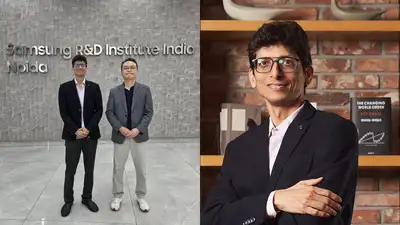
Kyungyun Roo, managing director of SRI-Noida and Amitabh Thapliyal, vice-president, SRI-Noida
Samsung Unveils Galaxy Watch Ultra2 and Galaxy Watch9 with Advanced Health Features
Samsung has launched the Galaxy Watch Ultra2 and Galaxy Watch9, introducing new health monitoring capabilities. Key features include Vital Tracking, which tracks heart rate, heart rate variability, and skin temperature; Cardio Load, which determines a user-specific exercise limit; and Trail Running, an enhanced mode for navigating varied terrains during runs.
These innovations have been largely developed at Samsung’s Research Institute in Noida, known as SRI-N. The institute recently opened its doors to showcase ongoing advancements in AI and health technology that underpin its Galaxy devices.
He noted that SRI-N was established roughly 20 years ago, in 2007, and today works primarily on Galaxy mobile phones, wearables, tablets and related software development. One such feature we launched is auto cycle detection.
When asked about any fail-safe mechanisms in Samsung’s health tracking features, like in scenarios when readings like skin temperature appear slightly elevated without any actual signs of illness, Amitabh Thapliyal, vice-president, SRI-Noida told The Times of India its teams run extensive validation testing whenever a new feature is developed, since early testing phases often throw up false detections. He said that the company works to trace the root cause of such issues and resolve them thoroughly before a product ever reaches the market, a process supported by close coordination with Samsung’s global teams. The challenge was: how do we accurately detect when a user is riding a bicycle using our sensor technology,” he told The Times of India .
Kyungyun Roo, Managing Director of SRI-Noida, gave an overview of the facility’s history and focus areas. Roo highlighted that AI has become a central focus for the centre, which has filed numerous global patents, particularly in AI and health-related domains, alongside publishing research papers at major international conferences covering AI, health, and networking. To build internal AI expertise, Samsung runs training programmes for its employees, including a dedicated AI certification course offered in partnership with IIT Ropar. The company has also set up SRI-N University internally, comprising schools focused on AI, technology, and leadership, alongside collaborations with leading universities and startups. Senior executives at the facility spoke at length on everything from how Samsung prevents false alarms in its health tracking systems to the privacy safeguards built into its wearables. “Before launching any product, we ensure all such complications are properly addressed. This level of rigor is achieved through our collaboration with our global teams. Let me share an example. During feature validation, we test under all conditions. To illustrate this, Thapliyal shared an example involving its auto cycle detection feature, which uses sensor technology to identify when a user is riding a bicycle. “During development, we encountered a unique issue in India. Here, auto-rickshaws often travel on bumpy roads. Initially, our system falsely detected these slow-moving auto-rickshaws as bicycles. To resolve this, our engineers and validation team conducted real-world field tests to identify such problems. Whenever such issues arise, we fine-tune our global algorithms to account for local conditions like those in India. This is just one example, but it highlights how our solutions are rigorously validated to ensure accuracy across diverse environments,” he explained.
All device processing occurs within this secure framework,” Thapliyal said. On the subject of AI-driven personalisation and user privacy, TOI asked whether Samsung bifurcates the information that is included when the AI is doing its work to give users a personalised, holistic approach, or it takes into account all the key matrices. Samsung explained that its technology relies on key data points like sleep patterns and activity levels to generate tailored recommendations through advanced algorithms while stressing that security remains a top priority throughout this process. “These inputs are processed by our technology, which uses advanced algorithms to provide tailored recommendations. A critical aspect to note is that Samsung prioritises security. All health data stored on the device is protected by Knox, ensuring a highly secure environment. “Additionally, when data is transmitted to the cloud with the user’s consent, it is end-to-end encrypted. Without user consent, neither Samsung nor any third party can access this data. We adopt a hybrid approach, focusing on building secure technology while emphasising on-device processing. This approach ensures both security and efficiency in our solutions,” he added. Get the latest technology news and updates. Download the TOI App.