
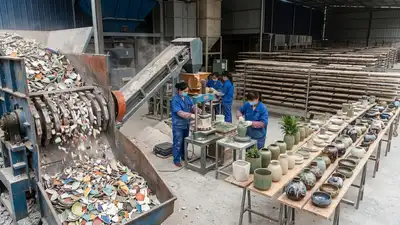
A broken plate or chipped cup usually has little value once it can no longer be used. In many places, such pieces are simply thrown away, joining a much larger stream of household and industrial waste. Jingdezhen, China’s historic porcelain centre, is taking a different approach to some of its discarded ceramics. Broken pieces from the city’s porcelain industry are being collected, crushed and processed into material that can be fired again. The recycled substance is now being used in products ranging from vases and planters to tableware and architectural materials. The practice is giving an old material a new role while addressing a growing waste problem.
By 1990, the city’s sewer network extended for more than 90,000 metres. More than 6,000 metres consisted of arched channels constructed using discarded kiln bricks. At least one drainage channel built in 1914 is still functioning. Official figures cited by Xinhua put the city’s discarded porcelain output at as much as 90,000 tonnes a year. One of its products is a permeable brick containing more than 90% recycled porcelain. The product received an iF Design Gold Award in 2022, giving an example of how material that was once treated as industrial waste can become a designed construction product rather than simply a cheaper substitute for new raw materials.
What might sound like an ordinary street name therefore carries a reminder of the material once used beneath it. The challenge is therefore not just finding somewhere to put broken plates, tiles or other factory rejects. Because it needs to be disposed of, companies are developing products in which the recycled material is the starting point, instead of recycling porcelain only.
That is the process behind XUN, a Jingdezhen brand whose name refers to recycling, according to Xinhua . The name Xianong, meaning “lower alley”, is associated with land that was reclaimed from a river using discarded porcelain. Zhang Jingjing, vice president of Jingdezhen Ceramic University, said recycling through crushing and reformulation is currently the most effective way to reduce the environmental impact of the waste. In 2024, the city introduced a “zero-waste city” initiative aimed at reducing waste generated during ceramic production and encouraging manufacturers to adopt new technologies.
The approach is relatively straightforward in principle, although turning discarded ceramics into something suitable for another product requires careful processing. Waste porcelain is collected and sorted before being crushed and purified. The resulting material can then be reformulated and fired again. Its products include vases, planters and tableware, with some finished pieces deliberately retaining tiny porcelain particles from the recycled material. The result is not intended to look like waste. Once processed and fired, the old fragments are difficult to distinguish from conventional ceramic material. The company has also experimented with sand-mould 3D printing, allowing recycled ceramic material to be used for larger decorative objects. Its products have been displayed at events including the China International Import Expo and the Canton Fair, while sales have reached customers in Europe and the Americas. For a city built around porcelain, the idea has a particular relevance. The discarded material is not coming from an unrelated waste stream. It is a by-product of the industry that has defined Jingdezhen for generations. Long before recycling became an industrial term, Jingdezhen residents had found practical uses for the debris left behind by its kilns. Broken porcelain fragments, old kiln bricks and spent saggers were incorporated into the built environment. They were used in foundations, walls and land reclamation, with some material placed into waterways to help raise the ground. In a city where porcelain production was taking place on a huge scale, throwing every broken piece away was never the only option. Some of that history can still be read in the city itself. Porcelain waste also found a place in Jingdezhen’s drainage system. Pieces were packed beneath roads to create porous layers through which rainwater could move towards underground channels. That was useful in a city vulnerable to flooding. The material once regarded simply as something left over from porcelain production became part of the city’s infrastructure. That historical reuse has not prevented Jingdezhen from developing a modern waste problem. A significant proportion has traditionally been dumped or buried. Unlike many forms of organic waste, ceramic material does not simply break down and disappear, leaving a long-term disposal issue for an industry producing it in large quantities. It is finding ways to return that material to productive use without creating another waste stream in the process. The new uses are not limited to the shelves of ceramic shops. Yi Design, a Jingdezhen startup, works with discarded ceramics to produce materials for architecture and art. The brick has applications in so-called sponge city projects, where urban surfaces are designed to deal with rainwater rather than allowing large volumes of runoff to collect on conventional hard surfaces. Such approaches have become part of efforts to address flooding and urban heat. Jingdezhen’s authorities have begun pushing that approach at city level. The programme also calls for discarded porcelain to be used in higher-value applications.
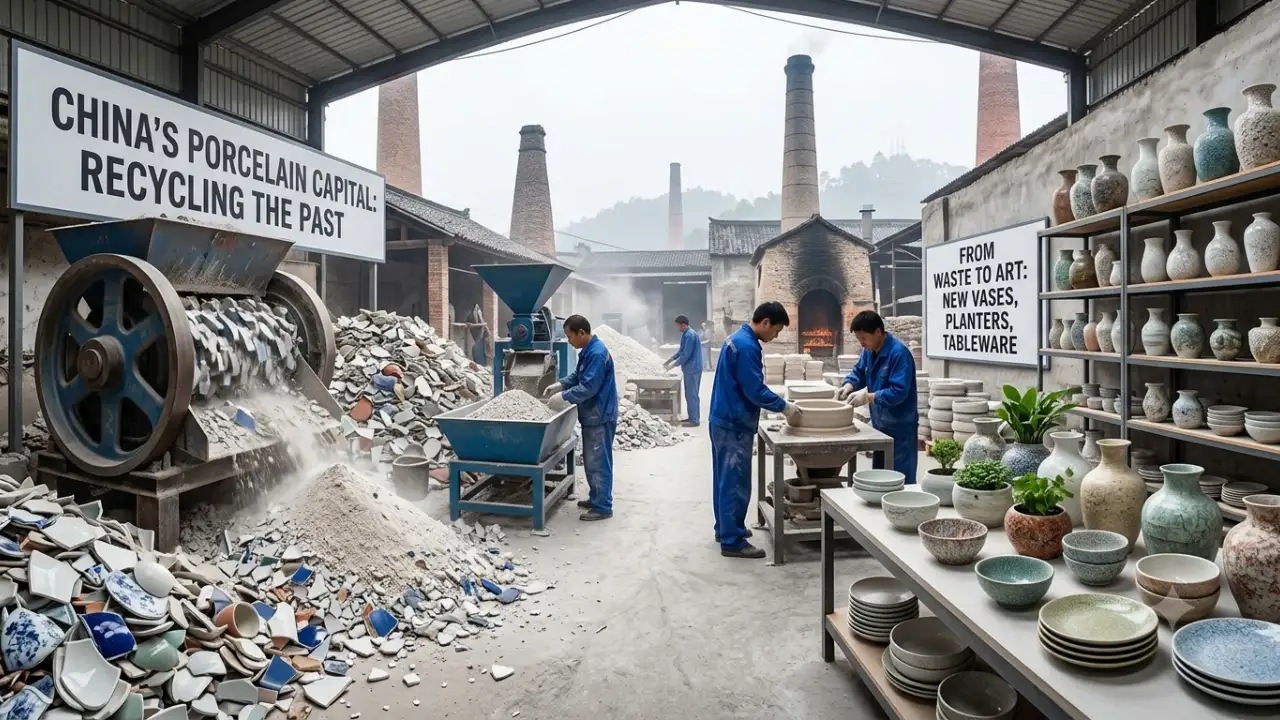
China released a circular economy development plan in July covering the 15th Five-Year Plan period from 2026 to 2030. Tong Xiwei, an official with Jingdezhen’s ecology and environment bureau, described ceramic waste as a longstanding obstacle to making the industry greener. The policy is intended to cover more than factories, with businesses, communities and residents also being encouraged to reduce waste and adopt more sustainable practices. The timing gives the effort another layer of significance. Among its aims are stronger systems for collecting and recycling waste, alongside technological improvements and industrial innovation. For Jingdezhen, some of those ideas are being applied to a material the city has been dealing with for hundreds of years. Catch the latest World News and Live updates. Download the TOI app.