
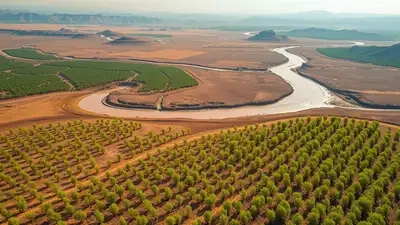
Representative Image of the Yellow River Basin with expanding planted forests across dryland regions, viewed from above (AI Generated Image)
The finding does not mean that every plantation stops absorbing carbon after 10 or 15 years. Because the 2 main tree species highlighted by the study, Robinia pseudoacacia and Pinus tabuliformis, typically take around 50 years to reach maturity, the timing is significant. The researchers therefore describe the decline in carbon-sequestration capacity as occurring much earlier than expected based on the trees’ biological maturity.
Rather, it describes a shift in the trend in annual NPP across the studied planted-forest areas, from increasing to declining. The authors interpret this as evidence that carbon-sequestration saturation can occur prematurely in the basin’s dryland plantations. The study examined several environmental factors that could influence carbon sequestration, including soil moisture, soil texture, temperature, drought and potential evapotranspiration. Of the individual factors assessed, soil moisture was identified as the strongest individual factor controlling carbon-sequestration dynamics. The researchers also found that interactions between environmental factors could have stronger effects than individual variables alone.
China’s Yellow River Basin has gained roughly 35,000 square kilometres of planted forest over the past three decades, but a study of nearly 20 years of monitoring data suggests some of those forests begin losing their carbon-sequestration momentum far earlier than their expected maturity. Research published in Scientific Reports titled Analysis of 20 years of monitoring data reveals insufficient carbon sequestration potential of planted forests in dryland regions found that annual net primary productivity, a measure used to assess vegetation carbon fixation, shifted from increasing to declining within 15 years of planting in more than 80% of the areas where planted forests expanded. In nearly half of those areas, the decline began within 10 years. The finding comes from an analysis of the Yellow River Basin between 2001 and 2019, using annual net primary productivity and soil organic carbon datasets alongside land-cover and climate data. The study’s overall results found that afforestation increased NPP by 34% during the initial restoration phase, but NPP subsequently declined by 10%. Over approximately three decades, planted-forest expansion accounted for an increase of around 35,000 square kilometres in the basin.
The researchers say increasing drought and limited water availability are among the factors restricting the long-term carbon gains of afforestation in this dryland region. The Yellow River Basin has been the focus of extensive ecological restoration since the 1990s, including large-scale afforestation programmes intended to reduce land degradation and improve ecosystem functioning. More than half of the basin receives less than 400mm of annual precipitation, however, leaving many areas with limited water availability for sustained vegetation growth. In areas undergoing ecological restoration, NPP initially increased substantially. Soil organic carbon also increased, although its rate of accumulation gradually slowed over time. The researchers found that the pattern was particularly pronounced in planted forests. The findings do not argue against ecological restoration altogether. Instead, the researchers say future restoration in dryland regions needs to account more carefully for local water availability and environmental conditions. They recommend more strategic spatial planning, the use of native or locally adapted vegetation where appropriate, continued ecological monitoring and greater consideration of grassland restoration in severely water-limited areas. For the Yellow River Basin, the study suggests that increasing planted-forest area alone cannot guarantee steadily rising carbon sequestration. The long-term effectiveness of restoration will depend partly on whether newly planted vegetation can be sustained within the water and environmental limits of the landscape.