
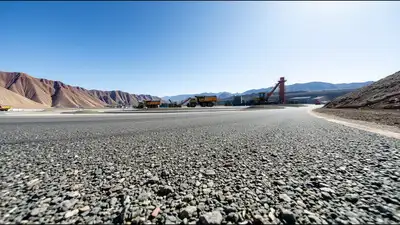
Representative Image of a pavement made from mining waste at Zijinshan Gold-Copper Mine, showcasing innovation in road construction (AI Generated Image)
The peer-reviewed study, Sustainable valorization of mine-derived solid wastes into cementitious pavement materials: Mechanical performance and microstructural insights , published in Sustainable Chemistry and Pharmacy in 2026, developed a pavement material made entirely from mine-derived wastes and tested it at the Zijinshan Gold-Copper Mine in Longyan, China. After 28 days of service, the 15% composite-solid-waste pavement section recorded 97.19% lower deflection than a granular blast-slag pavement base. The test roads were exposed to 100-tonne truck traffic and seasonal rainfall. A separate 2023 review in Minerals, Mining Wastes as Road Construction Material: A Review , found that mine waste has been tested or used in applications ranging from road bases and subbases to embankments and asphalt. The 2026 study takes that research into an operating mine. The field sections were constructed on haul roads at the 670-metre and 730-metre levels of the waste dump area. The roads were exposed to 100-tonne truck traffic, and the field evaluation measured performance after 28 days of service. After 28 days of service, the pavement containing 15% composite solid waste, known as FCBN-15, recorded a deflection of 7.62 hundredths of a millimetre. The granular blasting-slag pavement base after 28 days, designated FCBS, recorded 271.54 hundredths of a millimetre. The researchers calculated that FCBN-15 had 97.19% lower deflection than FCBS. It also showed 63.90% lower deflection than the natural rock pavement and 73.02% lower deflection than the natural soil pavement tested in the study. The researchers calculated material costs ranging from $3.94 per square metre for the 3% formulation to $6.99 for the 15% formulation. The 9% formulation cost $5.86 per square metre, compared with $6.92 for the cement-stabilised base and $6.81 for the fly-ash-stabilised base. The authors concluded that the 9% formulation offered a balance between performance and material cost, rather than finding that the strongest 15% formulation was automatically the cheapest option. For the 15% formulation, leaching tests measured 0.007 mg/L of cadmium, 0.00003 mg/L of mercury and 0.02 mg/L of chromium.
Because different mines produce materials with very different physical and chemical properties, it also notes that the approach has not yet been adopted on a large scale, partly. The researchers reported that all three met the groundwater IV standard used in their assessment. Gold mining produces more than the metal that eventually leaves the mine. Open-pit operations also generate large quantities of solid waste, including rock, slag and other residues that must be managed and stored. A new study has tested whether some of that material can instead be turned into part of a working mine road. Instead of relying only on laboratory specimens, the researchers constructed field sections using a composite material made from blasting slag and neutralised dreg, amended with additional composite solid waste. The resulting pavement material was derived entirely from mine waste, allowing the researchers to examine its behaviour under actual mine traffic rather than only controlled laboratory loading. Pavement deflection measures how much a road surface deforms when a load is applied. Lower deflection indicates greater resistance to deformation, which is particularly important for haul roads carrying heavy vehicles repeatedly. At the Zijinshan mine, researchers tested several pavement bases. Cost results were more complicated. The study also included leaching tests. These results provide short-term environmental evidence for the tested material, but they do not establish that every type of mining waste would be environmentally suitable for road construction.
What still needs testing before mining waste roads become widespread
The field evaluation in the 2026 study was conducted after 28 days of service, meaning it does not establish how the pavement will perform after years of repeated heavy-truck loading, seasonal weather and changes in mine operations. The 2025 road-construction review similarly identifies material variability, leaching and the absence of standardised design protocols as unresolved issues. Because mining waste is not a single material, that limitation is important. Because of differences in placement and curing, a 2026 review titled Geopolymerization of Mine Tailings for Pavement Applications: Properties, Limitations and Future Directions , notes that field conditions can produce lower strength than laboratory specimens.
The biggest limitation is time. The authors themselves describe the field evaluation as a short-term assessment. Its chemical composition, particle size, strength and environmental behaviour can vary considerably between mines. Other research is also moving beyond laboratory testing. It also highlights the need for repeated-loading and long-term durability studies before such materials can be assessed for broader pavement use. For now, the Zijinshan trial provides a useful piece of field evidence rather than a universal solution. It shows that mine-derived waste can be engineered into a pavement base capable of resisting substantial deformation under heavy mine traffic, while also reducing the calculated carbon footprint relative to the conventional materials tested. Whether the approach can be safely and economically reproduced at other mines will depend on the composition of their waste, local environmental requirements and longer-term performance under real traffic.
That does not mean the waste-based road will last 97% longer or require 97% less maintenance. The 9% formulation showed substantially higher deflection than the 15% formulation after 28 days and deteriorated when subjected to more than three wetting-drying cycles.The 15% formulation showed the lowest deflection in the field test, but it was also more expensive. The authors identified the 9% formulation as offering a balance between performance and material cost, while noting that longer-term field evaluation is still required. Their simplified cradle-to-gate assessment estimated total carbon emissions of 7.466 kilograms of CO₂ per square metre for the 9% composite-solid-waste material and 7.495 kilograms for the 15% formulation. By comparison, cement-stabilised and fly-ash-stabilised materials produced 14.043 and 13.430 kilograms of CO₂ per square metre, respectively.
The study measured deformation resistance over a short field period. Still, the result provides field evidence that the material can resist deformation under demanding operating conditions. The researchers also found that performance depended on the amount of composite solid waste used. Mechanical performance was only one part of the study. The researchers also examined environmental and economic factors.