
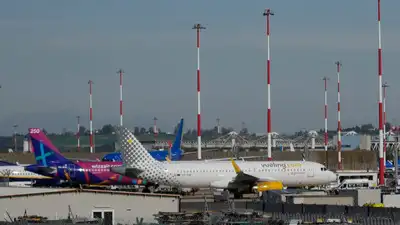
Aircraft sit on the tarmac at Leonardo da Vinci International Airport in Fiumicino, near Rome, Thursday, Nov 5, after a flight from Dublin to Rome was diverted to France amid reports of bomb threats targeting multiple flights across Europe. (AP Photo/Gregorio Borgia)
At least 30 aircraft and several airports across Europe were targeted by bomb threats on Thursday, disrupting airline operations across eight countries in the second major wave of such incidents in a week. Romanian authorities evacuated nearly 200 passengers from the Bucharest-bound aircraft and deployed an explosives disposal team to inspect it. EasyJet later confirmed that its flights from Newcastle and Glasgow were among those affected. Bomb disposal experts inspected the aircraft on arrival, Italian news agency Ansa reported. Iberia subsequently confirmed that two of its flights, travelling from Milan and Rome to Madrid, were affected. Italian media first reported the contents of the emails, which were subsequently confirmed by the airport operator.
The UK government described the latest warnings as “malicious hoax threats”. The latest incidents affected flights operated by several airlines, including Aer Lingus, Finnair, Wizz Air, LOT, Ryanair, EasyJet, Aegean Airlines, Iberia and Air Serbia, according to a BBC report. The airline said it was working to “re-accommodate customers to their final destination as soon as possible”. Polish airline LOT said its flight from Warsaw to Brussels landed as scheduled and that “no suspicious items were found”. Three Ryanair flights were also affected in Bulgaria, according to local media. “Passengers on both flights disembarked normally,” the airline said. Aegean Airlines said it had been informed of bomb threats concerning two flights, one travelling from Thessaloniki to Milan and another from Athens to Vienna. The airline described the threats as “unfounded”. Air Serbia said its flight from Belgrade to Bucharest landed safely. Following security checks, the reported threat was “assessed as unfounded”. Heathrow said it had received a threat earlier in the day but stressed that there was “no risk to passengers, colleagues or the aircraft”. “There are robust UK aviation security standards in place to assess and safely manage these types of situations,” the airport said. A Birmingham Airport spokesperson told the BBC that the airport had received a threat, following which “processes were immediately initiated in conjunction with emergency services and partners”. UK Transport Secretary Heidi Alexander described the incidents as “malicious hoax threats”. She said the government was taking “these threats seriously”, adding that there were “established processes for dealing with hoax and malicious threats”. A UK government spokesperson later said the threats reported “in the early hours” had been “resolved”, without providing further details. The warnings were signed in the name of a group or individual calling themselves “Fighters of the Male State”. The messages claimed to be targeting a “feminist regime” and said they wanted to “make our mark on history”. They also threatened to “turn the skies red” with explosions.
Flights involving Austria, Belgium, Bulgaria, the Czech Republic, France, Italy, Poland and Romania were affected, prompting diversions, fighter jet escorts and extensive security checks. No explosives have been found so far. Some aircraft were diverted to alternative airports, while others underwent security inspections after landing. Several airports also activated emergency procedures following the warnings. An Aer Lingus flight, EI402, travelling from Dublin to Rome was diverted to the Évreux-Fauville air base in Normandy, France. The aircraft landed safely after a security alert. A Finnair flight from Helsinki to Rome was escorted into Rome’s Fiumicino airport by Italian Air Force fighter jets. Another Finnair flight from Helsinki landed in Vienna. Italian authorities subsequently carried out security checks on the aircraft. In a separate incident, two Wizz Air flights departing from Milan were affected. One flight, bound for Warsaw, was diverted to Vienna, while another landed safely in Bucharest. Another LOT flight, travelling from Warsaw to Paris, was stopped before take-off. The aircraft and its baggage underwent security screening, with no hazardous items found. Flights from Copenhagen and Madrid landed in Sofia, while another aircraft travelling from London to Sofia landed in Plovdiv. The aircraft were escorted by Bulgarian Air Force fighter jets. In the Czech Republic, police received threats involving four aircraft heading to Prague. Authorities assessed the warnings as low risk but activated security procedures. A Ryanair flight from Porto in Portugal landed safely in Milan as scheduled. Spain’s airport authority also received threats involving three flights at Madrid airport. Inspections ruled out any danger. It remained unclear whether the third aircraft was the Ryanair flight from Madrid to Sofia. The disruption extended beyond aircraft. The source of the latest threats remains unclear. However, emails sent to airport authorities in Rome offered a possible lead.
London Heathrow and Birmingham airports received bomb threats on Thursday, although the warnings were assessed as not credible. Aeroporti di Roma, which manages the Italian capital’s two airports, confirmed to the BBC that the threats against two inbound flights on Thursday had been received by email.
Because of its extremist views, the ultra-right group was banned by a Moscow court in 2021.
The name “Fighters of the Male State” is believed to refer to the Russian group “Muzhskoi Legion”, or “Male Legion”. However, it continued to retain tens of thousands of online followers and voiced support for Russia’s full-scale invasion of Ukraine the following year. There is no confirmation that the group was behind the latest threats. It is also unclear whether the emails were genuine or whether the incidents across Europe were connected. The latest disruption comes two days after at least seven European flights, including two from the UK, and a cruise ship received bomb threats. Security checks were conducted across airports, but no explosives were found. The repeated incidents have raised concerns about the vulnerability of European aviation to coordinated or copycat disruption. they have forced airlines and airport authorities to divert aircraft, evacuate passengers and conduct extensive security checks Although the warnings have so far proved unfounded. You use AI every day. Now get your AI Quotient. Take the AIQ test.
On Monday, a separate Wizz Air flight travelling from London Luton Airport to Sofia was escorted by a Hungarian fighter jet to Budapest following a mid-air bomb threat.