
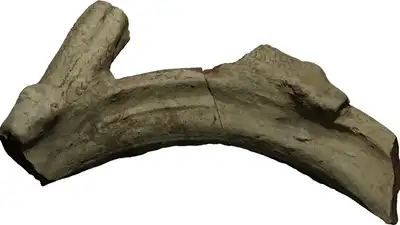
PC: Study- Of snakes and gods: early evidence for the cult of Sabazios in the Roman villa of Collet
The fragments were recovered from the Roman villa of Collet, which sits on a rocky outcrop roughly 20 metres above the Bay of Palamós, in the ancient territory linking the ciuitates of Gerunda and Emporiae.
Titled ‘ Of snakes and gods: early evidence for the cult of Sabazios in the Roman villa of Collet ’, the site was first identified in the late nineteenth century, according to the study published by Cambridge University Press. At the Roman villa of Collet, on a low cliff above Spain’s Bay of Palamós, archaeologists have uncovered fragments of a large ceramic vessel that appears to reveal one of the empire’s more secretive religious practices. Its handle, moulded into a two-headed serpent covered in tiny incised scales, was broken and buried close to a bread oven sometime during the Augustan period, roughly two thousand years ago. Researchers now argue the piece belonged to the cult of Sabazios, a Thracian and Phrygian god whose worship in the Roman world rarely left the home. Evidence for the cult on the Iberian Peninsula is thin, mostly clustered near the ancient city of Emporiae, making the Collet find a rare rural example. Laboratory testing of the vessel’s clay points further still, suggesting it may have travelled from Roman Africa rather than being made locally, hinting at how far the cult’s quiet influence could reach. Evidence for the cult on the Iberian Peninsula remains sparse, largely confined to its northern edge. A bronze bust interpreted as a Sabazios figure was found at l’Alcúdia near Elche, a bronze hand recovered off Cartagena is thought to have come from a shipwreck, and a possible sanctuary at the Cueva Negra site in Murcia remains disputed among scholars. The strongest evidence lies near Empúries, the ancient city of Emporiae, where an Augustan-era tomb produced a triptych of bronze plaques depicting Sabazios and the twin gods Castor and Pollux, suggesting an itinerant priest may once have carried the cult inland from the coast.