
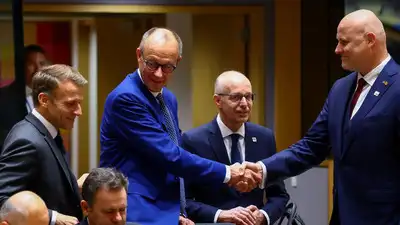
File photo: French President Emmanuel Macron and German Chancellor Friedrich Merz
Because france and Germany had already agreed to deepen cooperation on deterrence, the issue is particularly relevant. In a joint declaration issued in March, Macron and German chancellor Friedrich Merz announced the creation of a high-level nuclear steering group to coordinate strategic cooperation, including conventional capabilities, missile defence and France’s nuclear forces.
France is now holding discussions with German officials to establish a common understanding of when and how such weapons could be deployed, according to six people familiar with the talks cited by the Financial Times. Russia, he said at the Berlin Security Conference last week, would tend to attribute an attack by one Nato member to the alliance as a whole. Germany’s defence ministry said it was developing deep precision strike capabilities jointly with Britain and exploring the possibility of including France.
Paris wants Germany’s approach to deep precision strikes (DPS) to be aligned with its own nuclear strategy, particularly over the risks of escalation and the messages military action could send to Moscow. One source of French anxiety is president Emmanuel Macron’s proposal for France to extend its nuclear deterrence discussions to other European countries. Under the concept of ‘forward deterrence’, Paris is exploring how its nuclear capabilities could contribute to the security of European partners, while retaining sole control over any decision to use its nuclear weapons. The declaration specifically identified deep precision strikes and the management of escalation below the nuclear threshold as areas for cooperation. The debate also raises questions about how individual European countries would coordinate long-range attacks within Nato. Germany’s growing capabilities are part of a wider effort involving Britain, Poland and Nordic and Baltic countries to strengthen Europe’s ability to deter Russia, particularly as uncertainty grows over the United States’ long-term security commitments under US president Donald Trump. General Ingo Gerhartz, the German officer who heads Nato’s command responsible for the defence of central Europe and its eastern flank, has argued that deep-strike decisions must be taken in consultation with allies.