
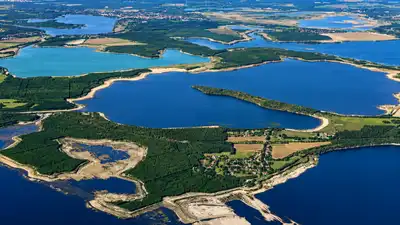
The tourist destination now comprises 23 post-mining lakes covering about 14,000 hectares of water. The transformation began with Lake Senftenberg in 1967 and has continued for decades, turning one of Germany’s major coal-producing regions into a new water landscape. In eastern Germany, enormous pits carved into the landscape by decades of lignite mining are being transformed into a vast network of lakes, wetlands and restored land. The Lusatian Lakeland, spread across Brandenburg and Saxony between Berlin and Dresden, is being created by flooding former open-cast mines and reshaping their surroundings. The project combines environmental restoration with tourism, recreation and long-term rehabilitation of land heavily altered by mining.
LMBV identifies 23 post-mining lakes within the tourist destination, with a combined water surface of around 14,000 hectares. In 2025, Sedlitzer See reached its planned water level, marking a major stage in the creation of the lake network. At about 1,400 hectares, it has become the largest recreational lake in the Lusatian region. On June 29, 2026, five major lakes were officially connected through navigable waterways, creating a continuous water area of roughly 5,100 hectares. LMBV says the wider plan involves 13 navigable canals, of which four have been completed, while others are under construction or in planning.
The Lusatian Lakeland is not a single giant lake but a collection of former mining sites that are gradually being integrated into a connected water landscape. Five of the most prominent are Senftenberger See, Geierswalder See, Partwitzer See, Sedlitzer See and Großräschener See. Their transformation has taken place over different periods, with Senftenberger See being the oldest of the group and Sedlitzer See among the most recent to reach its target level. The transformation is extending beyond the creation of individual lakes. Canals are being constructed to connect several of the former mining pits, allowing boats to move between lakes that were once separated by mining infrastructure and spoil heaps. The network includes Senftenberger See, Geierswalder See, Partwitzer See, Sedlitzer See and Großräschener See. The new connections are intended to support boating and passenger shipping while creating a unified tourism destination from landscapes that were once dominated by mining.