
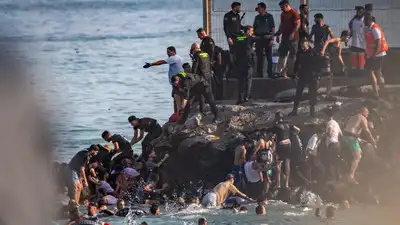
The documents, which include intelligence reports, alerts and internal communications from July 1 to 31, show that Spanish agencies were tracking a growing movement of migrants and online calls for a mass crossing before the surge on July 30.
“There are two different groups with a total of 180,000 followers. The CNI also alerted Spain’s Civil Guard and sent a report to Moroccan intelligence agencies DGST and DGED about plans to enter Ceuta on July 30.
In a WhatsApp message to the Spanish government’s delegation in Ceuta, the CNI warned of calls for “an assault on the fence and by sea tomorrow at 8 pm” The agency said two social media groups involved in the mobilisation had a combined 180,000 followers. The warnings said migrants could try to take advantage of Morocco’s annual Throne Day celebrations. A separate urgent memo referred to “several calls to carry out entries into Ceuta” on Facebook, including one group with more than 160,000 members.
Just to give you an idea of the scale,” the CNI wrote. The declassified material indicates the mass crossing did not emerge without warning.
The government and Moroccan counterparts were warned a day before more than 70,000 people crossed into Ceuta, according to 40 documents declassified on Wednesday. The documents, which include intelligence reports, alerts and internal communications from July 1 to 31, show that Spanish agencies were tracking a growing movement of migrants and online calls for a mass crossing before the surge on July 30. On July 29, Spain’s National Intelligence Centre (CNI) warned of calls on social media for migrants to enter Ceuta by climbing the border fence or swimming around it the following day. Spain’s National Police border division, CENIF, said almost 1,000 people had swum into Ceuta from Morocco between July 1 and July 28. The July 30-31 surge has also left a prolonged humanitarian crisis in the Spanish enclave. NGOs estimate that more than 140 migrants died during the mass crossing. Local authorities say more than 10,000 migrants, including unaccompanied minors, remain in Ceuta, while the national government has put the figure at around 5,000.
It described the increase as a “drastic upward trend compared to last year” and a “consolidated and priority threat”. It said the increased presence of Moroccan police and gendarmes had proved insufficient to control the crowd. Sánchez said last week that there was no evidence to conclude that Moroccan authorities had planned or carried out the border rush. His position has come under renewed scrutiny after a leaked Spanish police report alleged “permissiveness” by Moroccan security forces. “The existence of this campaign was known … and was being monitored, but in no way did it constitute or could it be interpreted as an indicator of the scale, nature, or probability of what happened afterward,” Sánchez wrote on X on Wednesday. I was not aware of any information of any kind pointing to the magnitude of the avalanche,” Albares told reporters. Earlier reporting noted: The trove of files, which includes letters, transcripts of WhatsApp conversations, internal charts and reports from multiple law enforcement and intelligence agencies, appear to undermine what Spanish Prime Minister Pedro Sánchez has said about about the level of prior warning the government had before the sudden influx took place.
Spain’s intelligence and security agencies had warned of mass migration into the Spanish enclave. The disclosures have put renewed pressure on Prime Minister Pedro Sánchez, who has insisted that the government had no information indicating the scale or nature of the influx that followed. The Spanish government has stopped short of saying Morocco orchestrated the episode. The Moroccan foreign ministry did not immediately respond to a request for comment. Sánchez has acknowledged that the social media campaign was known to authorities but rejected the suggestion that it amounted to a warning of the crisis that followed. Foreign Minister Jose Manuel Albares also defended the government’s position. “I am speaking as Spain’s foreign minister, within my remit and based on what I experienced that day. The government argues that while agencies knew about planned crossings, the intelligence did not indicate that tens of thousands of migrants would enter Ceuta. Many are living in makeshift camps or on streets and beaches. The situation has triggered near-daily protests by residents angry over the government’s handling of the crisis.
Earlier reporting noted: Major protests in Spain have taken place in response to the arrival of the migrants, with critics blaming Sánchez’s government for the crisis. Earlier reporting noted: Spain’s intelligence agency issued several warnings about plans to breach border before Ceuta crisis MADRID — Spain’s national intelligence agency issued multiple warnings before the Ceuta border crisis about a potential mass crossing of migrants from Morocco into the Spanish exclave in late July, according to declassified documents released by the government on Wednesday.
A Spanish defence ministry presentation on July 30 said around 1,700 migrants had arrived by sea since July 25. The intelligence reports also said many people were already waiting to enter the water on the night of July 29.
It warned that “more intrusions are to be expected in the very short-term” and described the situation on the Moroccan coast near Ceuta as “migratory chaos”. A military intelligence assessment on July 30 said it was “highly likely that the Moroccan authorities are not actively encouraging the migratory wave, but have so far acted in a negligent and passive manner”. Another CNI report said: “At the operational level, no proactive response from Moroccan authorities was observed regarding the loss of control over the situation, beyond the deployment of a few riot control units.
Several hundred migrants subsequently swam towards Ceuta. Reports issued after the crossings began also raised questions over the conduct of Moroccan security forces. Catch the latest World News and Live updates. Download the TOI app.
The release of the documents is expected to intensify the political dispute over whether Spanish authorities acted quickly enough despite receiving warnings in the days and hours before the mass crossing.