
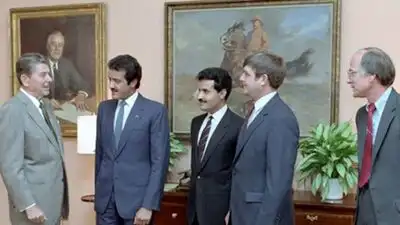
PC: Ronald Reagan Presidential Foundation and Institute
In June 1985, Saudi Arabia’s Prince Sultan bin Salman bin Abdulaziz Al Saud travelled into space aboard the American Space Shuttle Discovery, becoming the first Arab in space. 1985: A Chronology, his journey brought together two parts of his life that rarely shared the same setting: the responsibilities of a member of the Saudi royal family and the experience of seeing Earth from orbit, according to Astronautics and Aeronautics. Prince Sultan’s flight took place during the June 1985 mission of the Space Shuttle Discovery. Astronautics and Aeronautics, 1985: A Chronology, he said, “I had a small experience after I came back from space. ! I always jogged over the same area in Houston, sometimes 15 miles a day, but when I came back and jogged over the same course, I noticed at least 50 percent more things in nature. His face appeared on thousands of T-shirts and letters arrived in large numbers, reportedly hundreds each day, according to the September 1985 report.
During his visit to Washington after the mission, Prince Sultan gave interviews, attended receptions and met government officials, including President Ronald Reagan, as part of a goodwill tour, as reported by Ronald Reagan Presidential Foundation and Institute.
He continued to pray five times a day and fasted for part of the flight, according to The Saudi Gazette report. Eventually, he said, the planet appeared as a single blue sphere moving against the darkness of space. The mission also coincided with Ramadan, adding a personal and religious dimension to his time away from home. When he returned, the prince found himself at the centre of an unusually public reception in Saudi Arabia, where his achievement had attracted attention far beyond the world of space exploration. His participation marked a first for the Arab world, while his position as a member of Saudi Arabia’s royal family gave the journey a particular significance at home. He travelled as a payload specialist, taking part in a Nasa mission rather than serving as a career astronaut. The flight offered Saudi Arabia a direct connection to the American space programme at a time when human spaceflight remained a relatively rare undertaking. For the prince, it was also an opportunity to experience a view of the planet that few people had seen for themselves. The timing of the mission presented Prince Sultan with a practical and personal challenge. His journey took place during Ramadan, the holiest month in Islam, when Muslims traditionally fast from dawn until sunset and observe daily prayers. Being aboard a spacecraft meant that some familiar religious practices had to be reconsidered. The prince sought guidance from Muslim scholars about how to observe his faith while in orbit. The normal reference points for prayer were complicated by the spacecraft’s movement around Earth, where the cycle of sunrise and sunset was far shorter than it was on the ground. With the spacecraft circling Earth, daylight and darkness alternated rapidly. The experience gave his religious observance an unfamiliar setting, combining a routine rooted in faith with the unusual conditions of space travel. Prince Sultan’s descriptions of the view from orbit moved beyond individual countries and borders. He recalled how his perspective shifted over the course of the mission, from recognising particular places to taking in larger geographical features. His observation was personal rather than a scientific conclusion about how spaceflight affects perception. Still, it offered a glimpse of how an extraordinary journey had influenced his everyday life. The streets and natural features were familiar, but his attention to them had changed. The prince’s return home brought a reception that he described as unusual for the country. Saudi Arabia welcomed him with a ticker-tape parade, with crowds gathering to see him and helicopters dropping paper over the celebrations. He recalled people of different ages reaching out to greet him, describing a level of public emotion that surprised him. The response extended beyond the parade itself. His flight had become a widely recognised event in Saudi Arabia, turning a technical achievement in space exploration into a public occasion. His appearances gave American audiences an opportunity to hear directly from the Saudi royal who had taken part in the shuttle flight. In the newspaper interview, he also spoke about his life outside official engagements. He described himself as a bachelor who did not drink or smoke, adding that these habits did not make him a dull person. The remark offered a lighter glimpse of his personality amid discussions of religion, international relations and the experience of travelling into space. You use AI every day. Now get your AI Quotient. Take the AIQ test.