
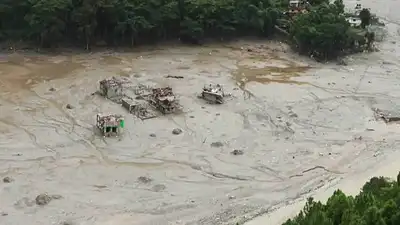
The death toll has crossed 1,100 as per police
‘India is powerful and like God to us’: What Nepal flood survivors said Meanwhile, survivors of the August 26 flash floods have been relying on immediate humanitarian assistance, including support from neighbouring India. In Nuwakot, the Nepal-Bharat Maitri Bhawan, which houses an Ayurveda and Alternative Hospital rebuilt with financial assistance from the Embassy of India after the 2015 earthquake, has become a refuge for displaced residents. Hospital chief Dr Narendra Prasad Giri said more than 100 displaced people were staying at the facility each night, while medical teams were also being sent to nearby shelters.
Nepal has launched a diplomatic push to seek climate-related compensation from major greenhouse gas emitters, including India, the US and China, as the country grapples with the devastating aftermath of deadly flash floods. A letter jointly signed by Finance Minister Swarnim Wagle and Forests and Agriculture Minister Geeta Chaudhary said the disaster had caused extensive economic and non-economic losses that exceeded Nepal’s immediate response capacity.
Nepal foreign minister Shisir Khanal said the Himalayan nation contributes “virtually negligible” greenhouse gas emissions but is bearing a disproportionate share of the consequences of climate change, including rapid glacier melt and extreme mountain disasters. The rapid melting of glaciers and these catastrophic mountain tsunamis are direct consequences of global climate change,” he said in an interview with Kantipur TV, excerpts of which were published by The Kathmandu Post. Khanal said Nepal was shifting its diplomatic approach from seeking “aid” to demanding “justice and compensation”. “This is not a matter of charity; it is a matter of legal and moral liability,” he said, adding that Nepal would raise the issue “with absolute firmness and clarity” at international forums. As per news agency PTI, the foreign minister identified China, the US and India as the world’s three largest greenhouse gas emitters and said they had a “historical responsibility to compensate vulnerable nations like Nepal. We are advocating not just for Nepal, but for the survival of South Asian civilisation,” he said. Many devastated people who were rescued from there, we brought them here and treated, and their health is now stable,” Giri told ANI. One survivor, recalling how floodwaters swept him away while he was trying to save his goats, said hospital staff reassured him after he was injured. “Here, the doctors and sisters (nurses) told me, ‘Don’t cry, we will save you, treat your wounds, apply medicine, and make you fine right here. They are treating me and helping me; I’m receiving good care and facilities,” he said. Expressing gratitude for India’s assistance, he told ANI, “Indian government is like our neighboring nation, a friend.
“We are paying the ultimate price for a global crisis we did not create. “This is a matter of civilisational survival. If our Himalayan glaciers disappear, the water security of over two billion people in South Asia dependent on rivers like the Ganges and the Trishuli will be permanently compromised. Nepal has also formally approached the Fund for Responding to Loss and Damage, seeking urgent financial assistance following the Bhotekoshi River basin flash flood. “This building is a post-earthquake reconstruction, and it was assisted financially by the Embassy of India. This building is a core support for the people. Now that this happened in Nepal, the Indian government has given us a lot of support. India is powerful and like God to us. Catch the latest World News and Live updates. Download the TOI app.