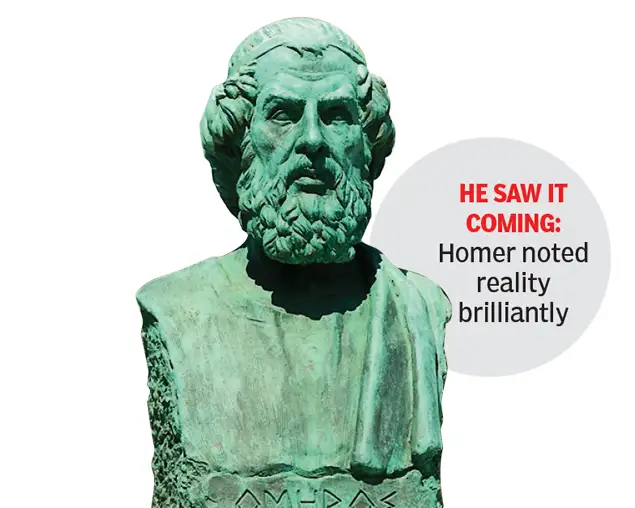
Homer’s 3000-year-old Greek epic sings a song about human beings’ relationships with nature. As Christopher Nolan retells this tale with Hollywood flair, many of us are still oblivious to its real meaning, writes Srijana Mitra Das in Times Evoke:
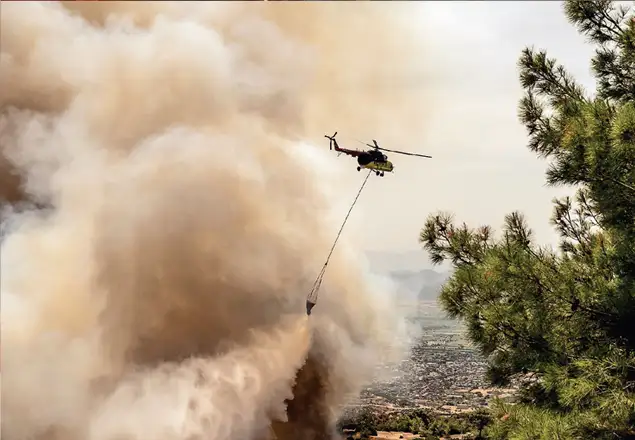
Yet today, scientists find Europe is warming faster than any other place on Earth, its terrain so heated that even the tiniest spark causes infernos which have, only this summer, already burned 5,00,000 hectares. The continent has been reeling under searing heatwaves that have killed over 10,000 people (can you imagine the international press if that happened, heaven forbid, in India?), toxic smoke exposing millions to air pollution levels above 300 micrograms. Hence, all three ancient Greek epics, the ‘Iliad’, ‘Aeneid’ and ‘Odyssey’, while featuring different stories, are bound by one common thread — the cruelty of humans to other species. Every epic literally groans with descriptions of animal sacrifices and feasts, rivulets of sheep blood running over grass and sand, spitfires crackling with butchered cattle, even the flocks of the gods not spared by humans, continuously hungry for sustenance or blessings. The epics don’t spare humans and their incessant needs — they are always portrayed as cowards who wheedle divinity for its gifts but ‘sacrifice’ the lives of the helpless to get these. To my mind, as I’ve been reading continuous reports lately of wildfires consuming large parts of Mediterranean Europe — including bits of the Peloponnesian Peninsula where the Odyssey takes place — Homer’s words and their implications remain vividly alive. Modern Europe — and here, I include Britain and the former USSR — in fact carved out the block of time termed the ‘Anthropocene’ from the medieval blur that preceded it. It was the restless predations of its explorers, knaves and thieves who succeeded the epic Greeks which began the first colonial voyages by sea. It was their discovery of gold, silver, diamonds and spices on foreign lands that led to the use of gunpowder and trickery to enslave local communities. It was their extraction of commodities which enriched their own societies — and fueled the industry that darkened pearly skies and harkened climate change. And indeed, it is their willful ignorance of the consequences of meddling with nature thus, their delusions about the environment and other species and their arrogant notion of being the centre of the world, that led to global warming. Perhaps Europe didn’t really expect the Anthropocene’s effects to come circling back home. Interestingly, Europe is not even alone in its climate emergency. Just a few weeks ago, the United States saw yellow-grey smoke drift across from Canada’s wildfires onto its shores, turning its skies a bilious orange, prompting angry words from its President — but not a squeak on climate action. Indeed, even as their own nations burn, we see another war over fossil fuels grow — Iran and the United States continue military clashes, pounding petroleum and natural gas plants, striking defence bases and littering sea and sky with more emissions and oil slicks for animals, birds — and eventually, humans — to choke on. Odysseus with song. So, why did Nolan choose a lotus so particularly, in an environment where the flower does not even naturally grow? Climate change is making its way into our cities — it is the Trojan Horse of our times and it will change life, whether we like it or not.