
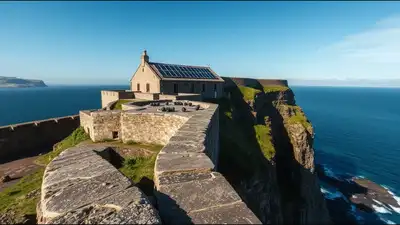
Representative Image of a restored Victorian fort on a picturesque Welsh island with solar panels and scenic ocean views (AI Generated Image)
In 2017, British tech entrepreneur Mike Conner bought Thorne Island, a ruined 19th-century fort off the coast of Pembrokeshire in Wales, for about £500,000 after seeing a video about the property online. Conner, the former chief executive of software company Appsbroker, subsequently embarked on an extensive restoration of the Victorian fort, investing around £2 million in the project. The result is a property with more than 8,000 square feet of accommodation, five bedrooms and enough space to sleep up to 20 guests. In August 2025, Conner put Thorne Island on the market for £3 million through Strutt & Parker. The fort was designed to accommodate a garrison of about 100 men and featured a seaward-facing artillery battery. Its original armament included five seven-inch Armstrong guns and four 68-pounder guns, mounted in open positions behind the parapet. Thorne Island’s military role eventually ended, and in 1947 the fort was converted into a hotel. It was sold for £275,000 in 1999, and in 2001 the Von Essen hotel group acquired the island with plans for a £4 million five-star hotel and a cable car linking it with the mainland. The island was sold again in 2011 and was put back on the market in 2016 before Conner acquired it the following year. Reports have put the overall investment at around £2 million, with a substantial portion devoted to renewable-energy and infrastructure systems. The finished property now contains just over 8,000 square feet of accommodation spread through the restored fort.
The restored island has solar panels, battery storage, heat pumps and other infrastructure that allows it to operate independently of mainland utilities. The landward side contained the defensible barracks, while the fort’s thick walls provided protection for the garrison and artillery. The property subsequently changed hands several times. Those plans did not materialise. The restoration included extensive work to the historic granite structure, as well as the installation of modern water, heating, sewage and electrical systems. These include solar panels, battery storage and heat pumps, while a dedicated sewage system and water-treatment infrastructure allow the island to function without conventional mainland utilities. Conner has described the project as a personal challenge undertaken after his career in technology. He bought the island after seeing it advertised as a derelict property and spent years turning the former military installation into a functioning private retreat. The restoration retained much of the original character of the fort, including exposed masonry, vaulted ceilings and the historic layout, while incorporating modern living spaces. The current sale listing describes five bedrooms, an open-plan kitchen and snug, large reception and dining areas, a games room and a rooftop bar. Several rooms retain exposed traditional brickwork and vaulted ceilings, while large windows provide views across the surrounding waters. The island also comes with its own private jetty and helipad, allowing access by boat or air. A hydraulic crane is used to move supplies and equipment between boats and the island, an important feature given that Thorne has no conventional road connection to the mainland. The property is being marketed for private residential use as well as potential commercial or hospitality purposes.
At the time, the island had no electricity or running water and the fort had been left in a derelict condition after earlier attempts to revive it as a hotel failed.