
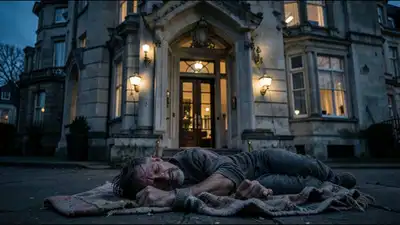
Representative Image of a lavish Knightsbridge mansion contrasting with a homeless man sheltering beneath its entrance (AI-generated image)
A London mansion that sold for £210 million in 2020 has remained unoccupied inside for years, while a homeless former journalist has made its covered entrance his shelter. Located at 2-8A Rutland Gate in Knightsbridge, the property has 45 rooms, 4 lifts, an indoor swimming pool and 116 windows, 68 of which overlook Hyde Park. Anders Fernstedt, a Swedish-born former journalist, has lived on its porch for about 3 years, sleeping beneath a makeshift tent made largely from umbrellas. In a June 2026 report, The Guardian documented Fernstedt’s life outside the mansion and the property’s complicated ownership history. The present building at 2-8 Rutland Gate dates from 1985–87 and was designed by the architectural firm YRM. Westminster’s 2021 planning report says it replaced earlier buildings on the site and was designed to mimic the architectural style of the 1860s. A later proposal to convert the property into 13 flats was never implemented. A certificate issued in 2019 confirmed that the building had been used as a single-family dwelling for more than 4 years. The present building was constructed in 1985–87 and became associated with Hariri as his London residence. He was assassinated in Beirut in 2005. The property was then given to Sultan bin Abdulaziz, the crown prince of Saudi Arabia, who died in 2011, according to The Guardian. The mansion’s contents, including ornate bathroom fittings, chandeliers and gold-leaf wastepaper bins, were auctioned in 2015. The property changed hands in 2020 for a reported £210 million, making it Britain’s most expensive house at the time. The house was put on the market again in 2022 for a reported £200 million but did not sell. Land Registry information cited by The Guardian identifies Vision Perfect Global Limited, a company registered in the British Virgin Islands, as the purchasing vehicle in 2020. The property’s ownership story took another turn on August 20, 2026, when a court in Shenzhen sentenced Hui Ka Yan to life imprisonment for financial crimes connected to Evergrande’s collapse. Evergrande, once one of China’s largest property developers, defaulted on its debts in 2021. Its liabilities exceeded $300 billion, and its collapse became a major episode in China’s prolonged property-sector crisis. The last change of ownership identified in the Land Registry information cited by The Guardian was the 2020 transaction. Fernstedt was born in Sweden in 1968 and worked as a journalist, writing technology articles for business publications. He later developed an interest in horticulture and enrolled at the Royal Botanic Garden Edinburgh in 2009 to study horticulture and plantsmanship, according to The Guardian. In its June 2026 account, The Guardian described Fernstedt’s experiences of insecure work, repeated no-fault evictions and an assault that left him with a ruptured eardrum. A report published by Berliner Zeitung on October 19, 2026, said Fernstedt had never been inside the mansion. The UK government’s Rough sleeping snapshot in England: autumn 2025, published on February 26, 2026, estimated that 4,793 people were sleeping rough in England on a single night. The estimate was 3% higher than in 2024 and 171% above the 2010 figure, when the current methodology was introduced. London recorded an estimated 1,277 people sleeping rough on a single night in autumn 2025, a 3% decrease from the previous year. Westminster remained the local authority with the highest estimated number, at 360 people. At Rutland Gate, the contrast is specific: a mansion sold for £210 million in 2020 remains unoccupied inside, while a former journalist has spent years living beneath its entrance. Fernstedt’s shelter, meanwhile, remains outside the building rather than within the 45-room residence.
Because of the ownership arrangements involving Ding Yumei, in its June 2026 report, The Guardian said Evergrande’s liquidators could not seize the property. It also reported that her assets had been frozen, leaving the property’s future uncertain.
Hui had pleaded guilty in April to charges including fraud and illegally taking public deposits, according to The Associated Press. His belongings include books, flowers, baskets, pictures and teddy bears. The contrast between the vacant interior and the makeshift shelter outside has drawn attention to the intersection of luxury property and homelessness in London. The site was acquired in the early 1980s by interests associated with Lebanese billionaire Rafik Hariri, who later became prime minister of Lebanon. The purchase was publicly associated with Cheung Chung-kiu, the Hong Kong-based chairman of CC Land Holdings. Following changes to transparency rules, Hui’s then-wife, Ding Yumei, was named as the company’s ultimate beneficial owner. The couple have since divorced. The court also imposed substantial fines on the company and related entities. The sentence does not establish that the London mansion itself has been confiscated or transferred. No later transfer is established in the sources used for this article. He subsequently worked briefly as a freelance fact-checker for The Economist. He also lived on a small sailboat in Essex and commuted to London for work. His freelance commissions eventually dried up, leaving him without a regular income. his belongings were stolen from the corridor of the building where he had been living While he was in hospital. He was left without his possessions or a place to go. Fernstedt began sleeping rough and eventually settled beneath the mansion’s covered entrance. Instead, he has gradually arranged his belongings around the porch, using flowers and containers to create what he describes as a pretend garden. His circumstances illustrate how homelessness can follow a series of setbacks involving work, housing insecurity and personal safety. His education and professional experience did not protect him from eventually sleeping outside. The circumstances at Rutland Gate sit within a wider housing crisis. This was the highest figure recorded under the current snapshot system. The government’s snapshot is a one-night estimate, not a count of everyone who experiences homelessness during the year. It does not capture the full range of housing insecurity, including people staying temporarily with friends or family or living in temporary accommodation. The government also cautions that rough sleeping among women can be less visible and may not be fully captured by the method used. Hui’s sentencing has added another development to the property’s complicated ownership story, but the mansion’s eventual future remains unresolved. You use AI every day. Now get your AI Quotient. Take the AIQ test.
However, The Guardian, citing earlier Financial Times reporting, identified Hui Ka Yan, founder of Chinese property developer Evergrande, as the ultimate owner.