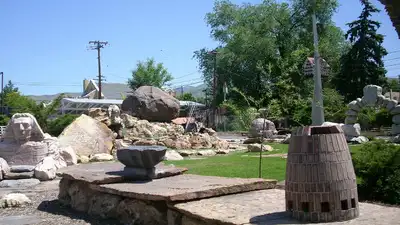
Gilgal Sculpture Garden in Salt Lake City was created by stonemason Thomas Battersby Child Jr. between 1945 and 1963. Image credits: Wikimedia Commons
Child’s start in 1945 at age 57 and the meaning of the name Gilgal The Salt Lake City public art program dates the start of the garden to 1945, when Child was 57 years old. A few other accounts give 1947, but 1945 is the date the city uses. Gilgal Sculpture Garden sits on a residential block east of downtown Salt Lake City, tucked between ordinary houses on a street most passersby would never expect to hold a sculpture garden. From the sidewalk, little signals what lies behind the fence. Inside, large stone figures stand among trees and lawn, and flat stones set into the ground carry carved text. Thomas Battersby Child Jr., a stonemason and an ardent member of the Church of Jesus Christ of Latter-day Saints who later became a bishop, designed the garden with help from an assistant and a sculptor. He saw the garden as a way to express his faith. The most recognized structure in the garden is a stone sphinx. Child took the name Gilgal from a biblical place associated with a circle of stones, the SPACES archive explains. In a statement quoted by the Utah State Historic Preservation Office, Child described the garden as an expression of his religion and of facts sacred to him. Building with Maurice Brooks, Bryant Higgs, an oxyacetylene torch and stones weighing tons
KSL reports that some stones weigh as much as 62 tons. The city’s public art program counts 12 sculptures and more than 70 stones carved with scriptures, poems, and literary passages. The SPACES record identifies the most photographed object as the 25-ton Egyptian sphinx, which bears the likeness of Joseph Smith, founder of the Church of Jesus Christ of Latter-day Saints. Child’s death in 1963 and the condominium plan that threatened the garden According to the Utah assessment, Child kept working at the garden until he died in 1963. Friends of Gilgal Garden , the 2000 purchase and the city park today The Friends of Gilgal Garden , whose history page dates the group to 1997, organized to prevent development and keep the site open for public enjoyment. The same history page notes that the Salt Lake County Master Gardener Association adopted the garden as a community project in 2001, and that the city council approved funding in 2013 to replace its aging irrigation system. The Smithsonian’s Art Inventories Catalog lists a Save Outdoor Sculpture assessment award in 2000 and a conservation treatment award in 2001.
The threat came later, when NBC News reported that a Canadian company had made arrangements to buy the mid-block area where the garden was located to build condominiums.
Brooks carved the most complicated pieces of artwork, while Child selected and arranged stones symbolically, according to the Utah historic preservation assessment. Child supported the use of the oxyacetylene torch for carving stones, according to the city’s public art program. In October 2000, Mayor Rocky Anderson reopened it to the public as a city park and called it “an absolute jewel,” the Deseret News reported in its article “Gilgal Garden reopens to public as a city park. ” In October 2000, Salt Lake City Mayor Rocky Anderson officially reopened Gilgal Garden to the public as a city park, describing it as “an absolute jewel,” as reported in the Deseret News article “Gilgal Garden reopens to public as a city park”. It is of significance in art at the statewide level, according to the Utah assessment.
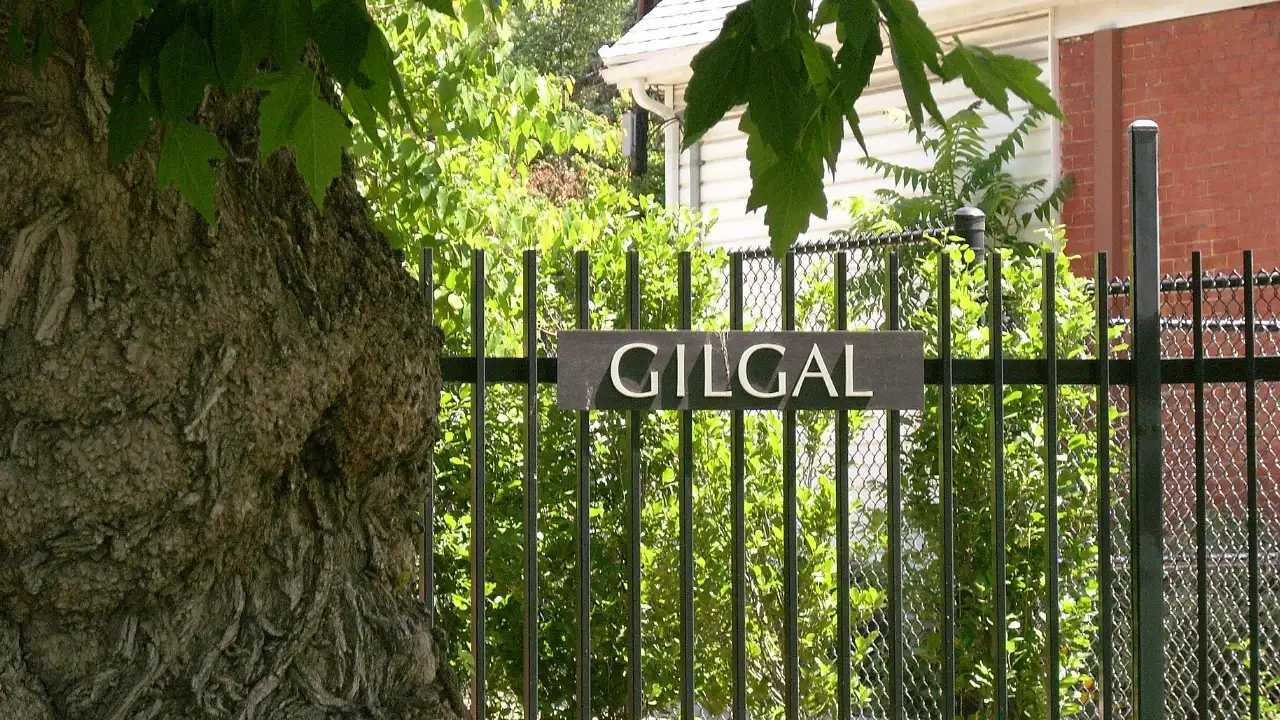
However, Child did not carve everything alone. The official Gilgal Sculpture Garden website’s About Gilgal article credits Child’s son-in-law and assistant, Bryant Higgs, with helping develop the torch-based stone-sculpting technique, which sculptor Maurice Brooks later learned and used to carve features on several sculptures. Later, Brooks used this technology to carve the sphinx’s face. Entrance of the gilgal. Image credits: Wikimedia Commons Scale was a part of the plan. Roadside America adds that the heaviest stones arrived by boxcar and were lifted into the yard by crane, details that the city’s and the garden’s own histories do not mention. After his death, the property passed into private ownership. The Trust for Public Land and the Salt Lake City Corporation worked together to acquire the garden. Recognition soon followed. The city’s public art program calls it the only visionary art environment in Utah. You use AI every day. Now get your AI Quotient. Take the AIQ test.
Maintenance of the garden has been continuous since then.