
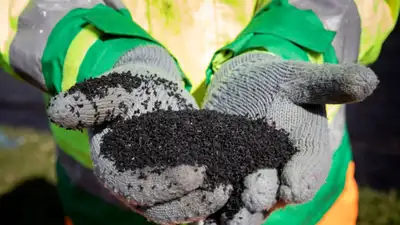
Britain began testing an unusual solution to its mounting tyre waste in 2019, when Highways England and construction company Tarmac laid a road surface containing recycled tyre rubber on the M1 near Leicester, according to a UK government press release published that August. Two years later, Tarmac said the material had secured BBA HAPAS Clause 942 approval for use on the UK’s strategic road network, marking a significant step towards its wider adoption. The trial tested whether granulated rubber from waste tyres could be incorporated into asphalt durable enough for a heavily trafficked motorway.
At the time, Highways England said around 40 million waste tyres were generated in the UK each year. The 2019 trial was intended to assess whether using some of that material in roads could provide an alternative to exporting or otherwise disposing of used tyres. Tarmac said in 2021 that the country was still exporting a significant share of its used tyres, making road construction an additional domestic route for tyre recycling. Tarmac said its rubber-modified asphalt had undergone a series of trials before the company announced in April 2021 that its ULTIPAVE R system had received BBA HAPAS Clause 942 approval.
The experiment was designed to test whether the material could withstand the demands of one of Britain’s busiest road networks while also tackling a growing waste problem. That figure is an estimate rather than a fixed number for every road. The amount of rubber that can be incorporated depends on the design and thickness of the particular surface. The approach also gives old tyres another use within the UK rather than sending them overseas. The M1 experiment was not an isolated test.