
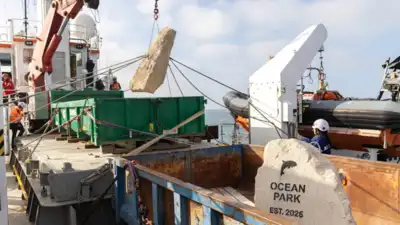
The Southern North Sea Marine Protected Area (MPA), designated to safeguard marine wildlife, has recorded the highest level of bottom-trawling activity among the UK’s offshore protected sites. Now, in an unusual attempt to protect its marine biodiversity, Greenpeace activists have dropped nine giant limestone boulders onto the seabed, creating what the organisation describes as an underwater barrier against industrial fishing.
The boulders, each weighing up to two tonnes, were deployed from Greenpeace’s vessel Arctic Sunrise on October 31, approximately 50 km off England’s eastern coast. The organisation announced the operation on November 2, claiming that the strategically placed rocks had effectively closed 116 sq km (approximately 45 square miles) of the protected area to bottom trawling. Bottom-towed fishing gear was used for at least 37,200 hours in the Southern North Sea protected area in 2025, more than at any other UK offshore MPA, according to Greenpeace UK. The Southern North Sea site is particularly important for harbour porpoises, supporting approximately 17.5% of the UK North Sea management-unit population, according to the Joint Nature Conservation Committee (JNCC).
This includes the immediate threat of death by bycatch, noise pollution, weakened visibility, habitat destruction, and critically, the mass depletion of the prey these mammals rely on for feeding and survival,” Greenpeace said in a statement. Bottom trawling involves fishing vessels dragging large, weighted nets across the seabed to catch fish. The method can damage sensitive underwater habitats, including corals, sponges and seagrass beds, while disturbing marine ecosystems and affecting species that depend on them. The organisation argues that these activities threaten the food supply and habitats of harbour porpoises, small marine mammals that inhabit the region. The animals can also become accidentally entangled in fishing nets, potentially preventing them from reaching the surface to breathe. “With no restrictions on bottom trawling, the harbour porpoise – supposedly ‘protected’ in these waters – instead faces a barrage of daily threats.
A government spokesperson said that legislation already protects marine sites, that damaging fishing activities have been banned in more than 100 locations and that further restrictions are being considered, according to reporting by The Guardian. Will McCallum, Greenpeace UK’s co-executive director, said the organisation had warned the government in June that it would take direct action if sufficient measures were not introduced to protect marine habitats. Actors Simon Pegg and Benedict Cumberbatch , alongside several British public figures and MPs, signed the boulders before their deployment.
With our ship and a movement behind us, we’re doing what the government isn’t: Protecting our seas,” McCallum said. The organisation said the signatures represented their support for stronger protection of marine ecosystems. “Hulking great ships prowl our oceans day after day, stripping them of fish and killing precious wildlife like dolphins, sharks and sea birds. The latest operation also has celebrity and political backing. Greenpeace also plans to patrol the area using the Arctic Sunrise in the coming days, aiming to discourage industrial fishing vessels from operating around the boulder placements. The UK government has also defended its broader marine protection framework. The government also stressed that activities at sea must be conducted lawfully and safely.